
Highlights from the 2006 F3J World Championships
While the 2004 World Thermal Gliding Championships in Canada had the smallest field of participants to date, this year’s World Championships in Slovakia stood out with the largest field yet, featuring 88 seniors and 43 juniors. The Slovaks, led by competition director Jaroslav Kostan, also excelled in every other aspect with their outstanding organization at the airfield in Martin, a city of 60,000 residents in central Slovakia.
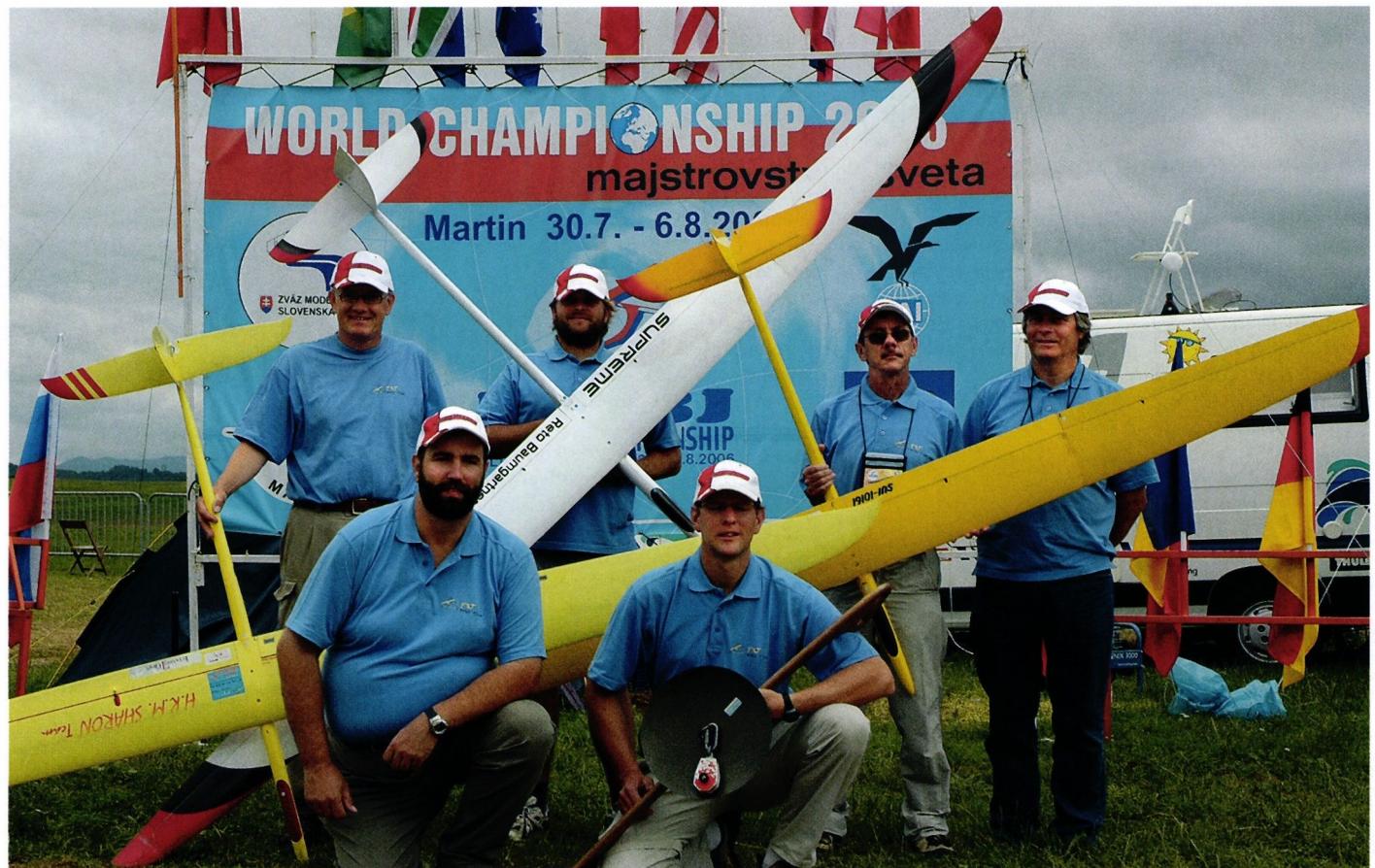
Our team consisted of volunteers Ivo Langensand and Robert Cames, team manager Ruedi Baumgartner, pilots Reto Baumgartner, Gusti Bieli, and Koni Oetiker, as well as this writer’s better half. In the model aircraft sector, quite a bit had happened on the market since Canada. Almost every manufacturer had something new to offer, though that didn’t mean it was actually available. For example, I received my Espada RL—which I’d ordered last October—a full 10 days before the World Championships! But using the model was worth it despite the very short break-in period. Reto and Ruedi had encountered this problem early on and therefore opted for a custom-built model, manufactured in their own workshop and christened “Supreme.” But R&R also had to learn the hard way that even that takes waaaay longer than planned. I’ll say no more about that here. Gusti relied on tried-and-true flying gear with the Sharon and Pike Superior.
Most of the team arrived on Thursday before the preliminary competition via the car train through Vienna and Bratislava. Amid the lingering midsummer heat, we immediately set up our tents in a good spot at a safe distance from the action. Everyone spent the rest of the afternoon doing a few test flights at the still-unfamiliar field. After we had set up our models and
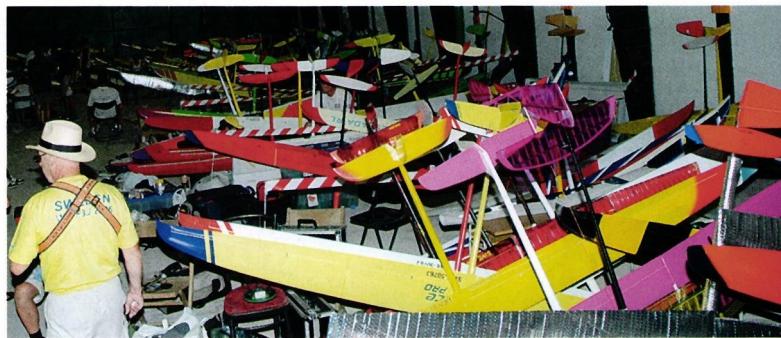
After storing our gear in the large hangar, we headed to the idyllically situated hotel. Over the next two and a half days, the Martin Cup took place with about 170 (!) pilots. In very hot and at times challenging weather, everyone was still trying to find the optimal settings and make a mistake or two right then and there, in the hope of reducing the number of potential mistakes at the World Championships. Did it work? The performance of the various new models—such as the Supra, Pike Perfect, Espada RL, and Supreme—as well as that of top pilots like Wurts, Borst, Strautins, and others, was closely monitored. Gusti held his own, Reto broke in his new models, and I made a few mistakes, such as launching into the sun. For Robert, the tent rescue operation on Sunday during the midday torrential thunderstorm marked the end of his volunteer work. As we found out later, he had broken his arm when he fell over a tent stake. Get well soon! After the weather cleared up again, Sunday afternoon was used for the model inspection, led by Raymond Pavan, who is well-known in F3B circles. It was astonishing how much last-minute chaos suddenly broke out among certain teams—some had no model registration cards, others had no stickers on their models, and so on. For us, the whole process was just a formality and was wrapped up in ten minutes. In the evening, the opening ceremony took place in Martin’s pedestrian zone with great fanfare, but thankfully with short speeches.
The first and only real technical meeting didn’t last too long either. The World Championship could begin!
The first start on Monday morning was scheduled for a reasonable 9:00 a.m., and thanks to the sun already being quite high in the sky (Martin is about 10° further east), the ten minutes weren’t a serious problem for Reto and me in the second and third groups, respectively. Gusti also handled his task with flying colors. At noon, we had to take another break because of
a severe thunderstorm. We barely managed to get our models into the dry just in time. Unfortunately, the second round—held in back-side weather—already saw the first disqualifications. What a shame, what a shame. Due to the poor weather forecast for the coming days, the organizer actually wanted to start as early as 7 a.m. on Tuesday. The majority of the teams then voted for the Swiss-style compromise of 8 a.m. Phew, the worst had been averted! But Gusti then got off to a disastrous start on the second day and suffered a bitter defeat against Philip Kolb and his Pike Perfect in the third round. It was my turn in the fourth round. Due to a technical problem that still hadn’t been resolved, I fell off the rope and had to switch to the backup model. For a long time, it looked as though I could make up the lost time by flying blind in the clouds alongside the rest of the group. Unfortunately, though, there was one person left in the end who stood in my way and flew right through. So much for the dream of a brilliant move. Reto continued to hold his own
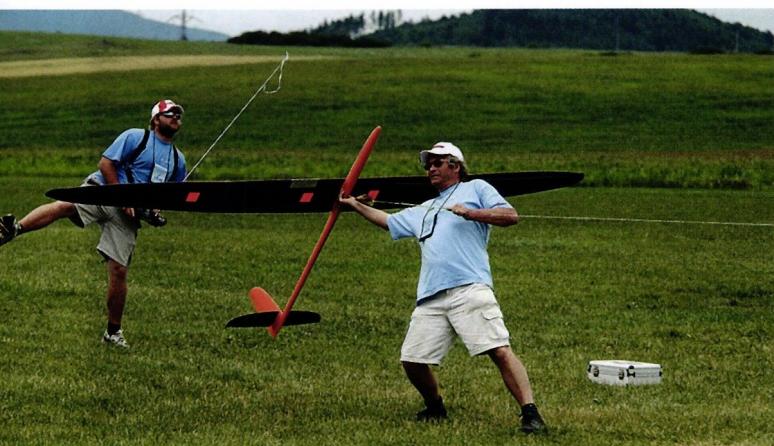
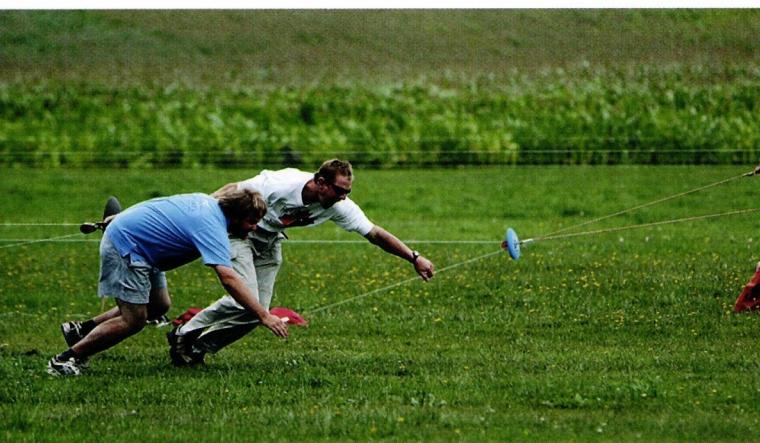
Brave. Joe Wurts, one of the clear favorites, was seen time and again over the next few days in the hangar patching up his A-model after he had a collision far out in the thermals. The weather deteriorated progressively over the next few days, and it was often completely overcast. Nevertheless, it was almost always possible to fly the ten minutes. There were also some spectacular incidents. For example, Arend Borst’s ultralight Supra came apart in a dramatic fashion while attached to the high-launch rope. But when you know the enormous tension the Canadians apply to the rope, it’s less surprising. My collision in the thermal was less spectacular, though perhaps the soft inverted landing in a crow’s-foot position was—because the elevator had stopped working. The following photo shows that the Swiss towing team was also among the best on the field.
Up until the tenth round, there were only very minor shifts in the top 12 fly-off rankings. Everything seemed settled until the start of the eleventh round. The thermal gods suddenly made things very exciting again and claimed their victims. Carl Strautins, for example, lost about 20 seconds and would have been eliminated after his flight. But luck remained on his side, and it definitely caught up with other pilots as the competition continued. In the end, Philip Kolb missed the fly-off by 0.5 points behind his teammate Sebastian Feigl. Marco Salvigni was also eliminated at the last moment. The junior and senior fly-offs took place on Saturday in very difficult weather conditions. But even here, at least one pilot in each round managed to stay airborne for fifteen minutes, albeit sometimes over incredible distances. In the junior category, the American—
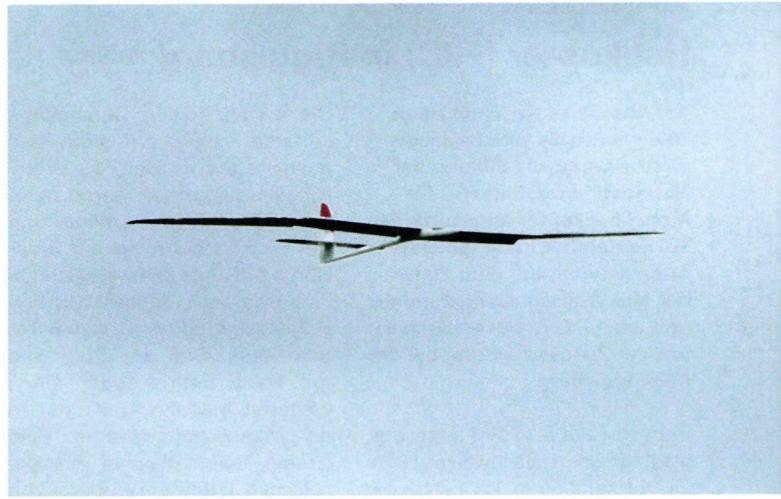
Cody Remington, flying the Espada RL, finished ahead of Benedikt Feigl and Casey Adamczyk. Things got very exciting in the seniors’ fourth flight. Reigning world champion David Hobby had built up a comfortable lead over the competition in the second flight, held his ground in the third, and was able to approach the final flight with confidence. But things got very tense again after he collided with Massimo Verardi at around the 13-minute mark, which severely damaged the left wing of his Pike Perfect. He kept his cool, though, and with a stroke of luck, he managed to land his plane within the 100-meter mark, earning enough points to stay in the lead. Verardi also did not request a refly, and so the old champion was crowned the new world champion. David Hobby had never been among the top contenders in the preliminary rounds, but he delivered a convincing performance in the
fly-off. The same goes for runner-up Sebastian Feigl and German-Canadian Rolf Oetter. Alongside the winners, however, there were also losers; for example, the fourth-place finisher at the 2004 World Championship, Craig Goodrum, finished a distant 73rd, while the 2004 Junior World Champion placed just a few spots ahead of him.
There is no definitive answer as to which model is the best. Both the Espada RL and the Pike Perfect have won world championships. The Supra is also a good, if unconventional, model. The decisive factor is likely which machine you can get your hands on in a timely manner.
We Swiss ultimately finished in 28th (Reto), 38th (Koni), and 46th (Gusti) place. As a team, we fought our way to 10th place out of 30 teams.
*Koni Oetiker*


News from HEBU

YOU KNOW WHAT I MEAN? 125 YEARS OF THE SWISS AERO CLUB
 Emil Giezendanner

F3A EUROPEAN CHAMPIONSHIPS IN ST-MACAIRE, FRANCE
 Matthias Bosshard

What's New at Leomotion.com

52. 2026 ALPS CUP
Emil Giezendanner
PRIDE AND GOOD IDEAS
 Markus Nussbaumer

EURO CONTEST GLIDER ACRO TOUR AUSTRIA 2026

TEAM MANAGER "THIS" BOSSHARD
 Rodito Nussbaumer

HORIZON HOBBY/LEMACO NEWS: MICRO OV-10 BRONCO 645 MM BY E-FLITE

BY YOUTH, FOR YOUTH
Lorena Betschen
CORSAIR F4U – A WARBIRD WITH A MEMORABLE LOOK
Jürgen Rosenberger, Jürgen Prinz
SMALL, MODEL-LIKE SAILBOATS
Res Dauwalder
TRY-OUT DAY AT MFV WETTINGEN
Urs Keller
34th HAHNENMOOS ALPINE MODEL AIRPLANE CAMP
Res Dauwalder
SUMMER FUN 2026 AT MG USTER
Martin Wunderli
WELCOME, NEW MEMBER!
Andrea Bolliger
FREE FLIGHT IN THE MIDDLE OF SUMMER
Urs Muntwyler
THE PC-21 STORY
Emil Giezendanner
TWIN TOWN PARTNERSHIP
Wolfgang Voeller
ATOM, THE NEW DOUBLE-DECKER FROM CPLR
Matthias Bosshard
COUPE DES ALPES – OBSERVE AND LEARN
Rodito Nussbaumer
INSIGHTS INTO THE HISTORY OF SEAPLANES

NEWS FROM HEBU
 Julia Bucher

FROM 0 TO 100
Markus Nussbaumer
MEMORIES
Wolfgang Völler
NOS REGION – A HUB FOR ELECTRIC AVIATION
Emil Giezendanner
A SPECTACULAR F3A WORLD CUP IN THE PRINCIPALITY OF LIECHTENSTEIN
Emil Giezendanner
Have you almost forgotten about aircraft that take off and land vertically?
Emil Giezendanner