
Energy costs for a battery charge
When I got home after a successful day of flying and plugged in the power adapter to charge my LiPo battery, I wondered: How much does it actually cost in electricity to charge it from a 230-volt outlet?
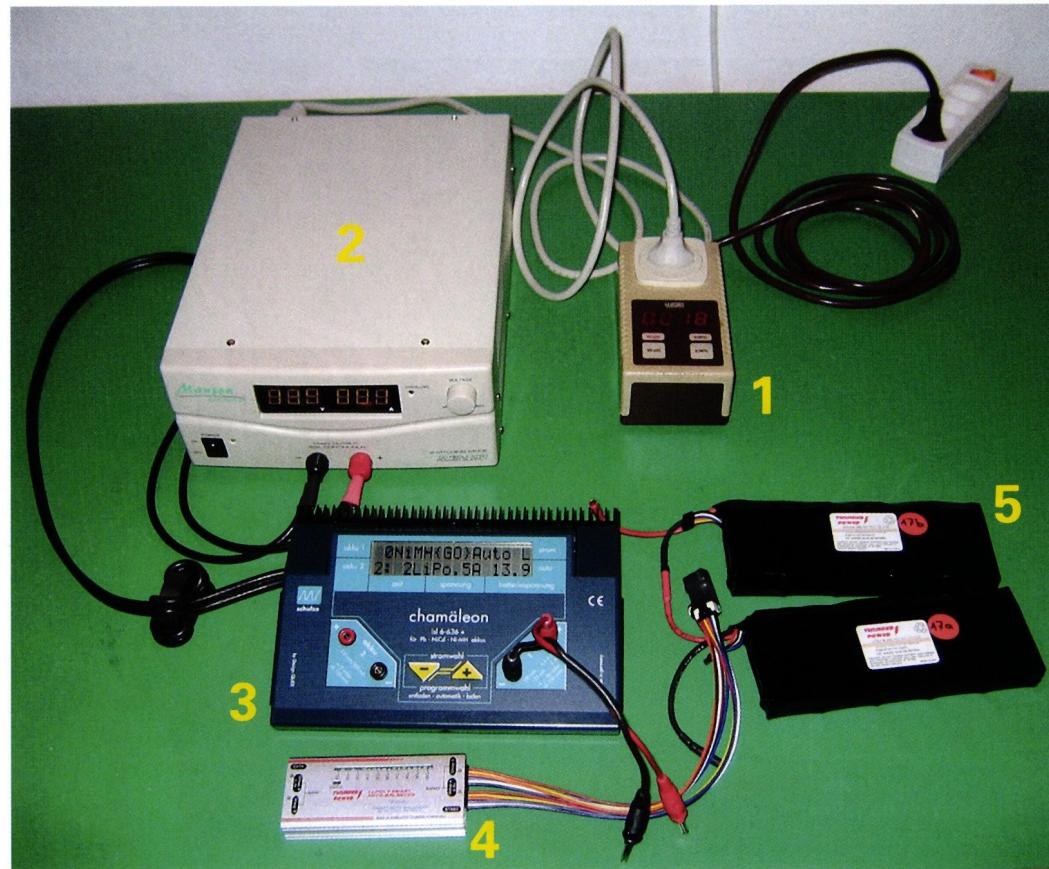
Sure, the cost in francs of the electricity used for our hobby is negligible. Still, I wanted to get to the bottom of it. So I got an energy meter to measure the kilowatt-hours (kWh) consumed from the outlet. I charge my batteries using the Schulze isl6-636+ charger. Today’s standard chargers operate on 12 V DC. The charger is therefore plugged into a power supply unit that steps down 230 volts AC to 12 V DC. Of course, the charger can also be powered by a 12-V battery, but this isn’t practical for larger batteries. So far, so good—and now for the interesting part. I’m now connecting the energy meter in front of the power supply, that is, between
the 230-V outlet and the power supply. I’m interested in the actual power consumption—the amount I actually pay for on my electricity bill (see setup below). I use the two LiPo batteries to power an electric motor in a 2-meter model weighing 5,000 g. After 8 to 10 minutes of motor runtime, an average of 4,000 mAh has been consumed. During flight, LiPo batteries should be discharged to a maximum of 80% of their capacity. The 10S4P batteries from Thunder Power that I use have a capacity of 5,300 mAh.
To fully recharge a battery pack in this setup, an average of 0.24 kWh of electricity is drawn from a 230-volt outlet. Assuming an electricity price of 15 Rp./kWh, this comes to 3.6 Rappen per battery charge. For 100 flights, that comes to about 3 francs and 60 rappen.
As I suspected at the beginning, the electricity costs are very low. Nevertheless, electric flight is a costly endeavor, especially with larger models.
However, one shouldn’t just consider the pure acquisition costs. With electric flight, the risk of experiencing an engine failure in flight is completely eliminated. An unplanned off-field landing can also be quite costly. In addition, maintenance costs are significantly lower.
Ultimately, the power system must also suit your personal preferences.
Wishing you all the best with your electric models,
Michel Hauser
1 Energy Meter
2 Power Supply
3 Charger
4 Balancer
5 Battery Pack 10S4P


News from HEBU

YOU KNOW WHAT I MEAN? 125 YEARS OF THE SWISS AERO CLUB
 Emil Giezendanner

F3A EUROPEAN CHAMPIONSHIPS IN ST-MACAIRE, FRANCE
 Matthias Bosshard

What's New at Leomotion.com

52. 2026 ALPS CUP
Emil Giezendanner
PRIDE AND GOOD IDEAS
 Markus Nussbaumer

EURO CONTEST GLIDER ACRO TOUR AUSTRIA 2026

TEAM MANAGER "THIS" BOSSHARD
 Rodito Nussbaumer

HORIZON HOBBY/LEMACO NEWS: MICRO OV-10 BRONCO 645 MM BY E-FLITE

BY YOUTH, FOR YOUTH
Lorena Betschen
CORSAIR F4U – A WARBIRD WITH A MEMORABLE LOOK
Jürgen Rosenberger, Jürgen Prinz
SMALL, MODEL-LIKE SAILBOATS
Res Dauwalder
TRY-OUT DAY AT MFV WETTINGEN
Urs Keller
34th HAHNENMOOS ALPINE MODEL AIRPLANE CAMP
Res Dauwalder
SUMMER FUN 2026 AT MG USTER
Martin Wunderli
WELCOME, NEW MEMBER!
Andrea Bolliger
FREE FLIGHT IN THE MIDDLE OF SUMMER
Urs Muntwyler
THE PC-21 STORY
Emil Giezendanner
TWIN TOWN PARTNERSHIP
Wolfgang Voeller
ATOM, THE NEW DOUBLE-DECKER FROM CPLR
Matthias Bosshard
COUPE DES ALPES – OBSERVE AND LEARN
Rodito Nussbaumer
INSIGHTS INTO THE HISTORY OF SEAPLANES

NEWS FROM HEBU
 Julia Bucher

FROM 0 TO 100
Markus Nussbaumer
MEMORIES
Wolfgang Völler
NOS REGION – A HUB FOR ELECTRIC AVIATION
Emil Giezendanner
A SPECTACULAR F3A WORLD CUP IN THE PRINCIPALITY OF LIECHTENSTEIN
Emil Giezendanner
Have you almost forgotten about aircraft that take off and land vertically?
Emil Giezendanner