
Free Flight Seminar in Aarau
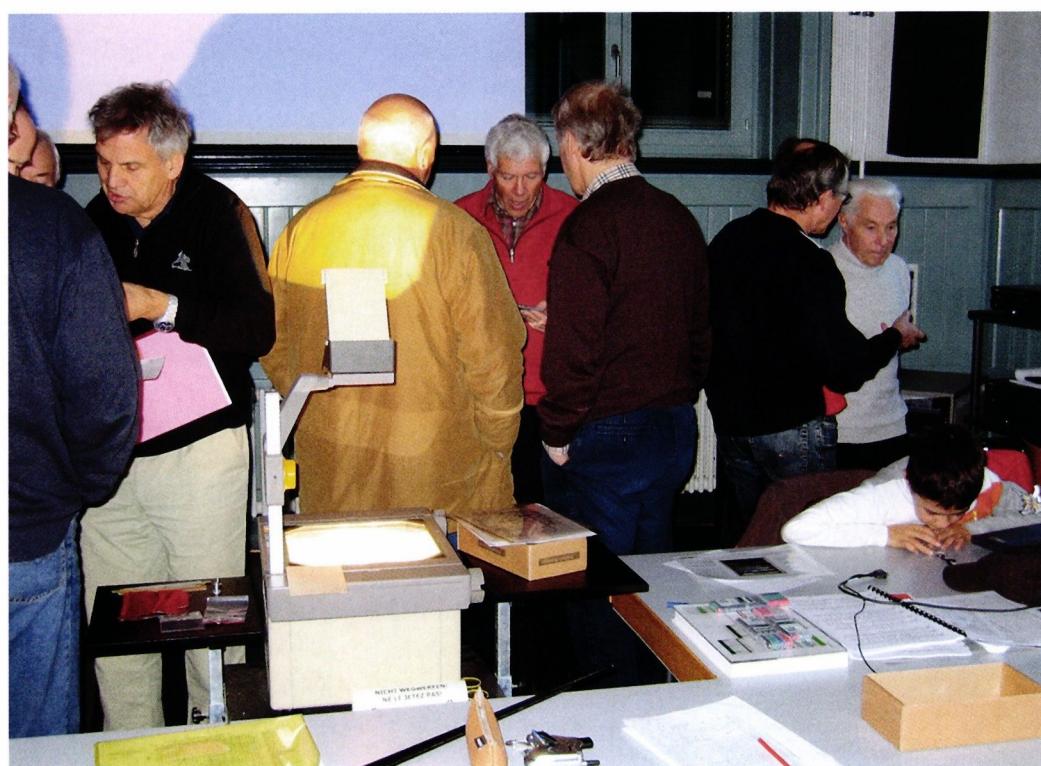
On February 3, 2007, a large number of free-flight pilots gathered at the Aarau barracks for the traditional free-flight seminar. The participants, some of whom were of retirement age, aptly chose “promoting the next generation” as this year’s main topic.
For several years now, the Free Flight Technical Commission of the Swiss Model Flying Association (SMV) has been inviting its pilots at the beginning of each year to an informal orientation and discussion on topics and issues related to free flight.
In his welcoming remarks, the new FaKo President, Christoph Bachmann, expressed his delight at the encouraging number of participants—especially given the small group of free-flight enthusiasts in Switzerland.
The meeting opened with a PowerPoint presentation on free flight by Jörg Strub, a member of the FaKo F1. It is intended to promote free flight and provide information on all categories within this discipline. Lasting 20 minutes, it is perfectly suited as a change of pace during a dry club meeting. For a
small fee of CHF 10, the CD can be purchased from: Jörg Strub, Grienweg 12, 4226 Breitenbach, Tel. 061 781 34 24, Email: J.Strub@unibas.ch
Walter Eggimann will serve as a representative of free flight on the newly formed SMV working group dedicated to this topic. It seems that people have recognized the untapped potential that young talent offers for model aviation. Just think of the vast possibilities offered by hands-on arts and crafts classes in schools. From my own experience, I know how clumsy and helpless—in the truest sense of the word—many teachers are in these classes when it comes to model airplane building, which is so popular among students.
The Working Group on Youth Development has therefore identified two key themes:
- a) Model building and schools
- b) Young Talent in Competitive Sports
Since various companies are currently promoting unsuitable, low-cost products for hands-on technology classes in schools, the FaKo Freiflug, on behalf of the SMV Working Group, has set itself the task of evaluating, in an initial phase, the beginner models available on the market that are suitable for this purpose. In a second phase, the goal is to provide teachers with appropriate methodological and didactic guidelines for using the models, and in a third phase, these materials will be promoted through the specialized media of teachers’ organizations and distributed via Swiss specialty retailers. However, the sustainability of this effort to promote young talent can only be ensured if “model aircraft students” receive ongoing support outside of school. In this context, I could certainly envision closer cooperation between schools and model aircraft clubs.
The first phase mentioned is already in full swing for FaKo F1, as Walter Eggimann was able to present seminar participants with an impressive number of tested and suitable beginner models. To meet the demand for
a simple free-flight motorized model, Martin Greub of MG Bern presented one. Based on a design by Ruedi Schenker, it is equipped with a 1-cc engine.
The promotion of young talent in competitive sports must primarily lie in the hands of model flying clubs. However, the FaKo F1 strives to offer support in this regard as well. To this end, it evaluates various commercially available performance models that meet today’s standards. It has found what it was looking for at the Latvian company W-Hobby (www.w-hobby.com). This company sells relatively affordable free-flight models for a wide range of skill levels—from beginner to expert—in various levels of complexity.
In addition, the SMV is looking for ways to reintroduce performance badges—which were once used in free flight many years ago.
Urs Müller demonstrated an electronic control system for F1E models (magnetically controlled gliders). This “intelligent” control system, developed by Heinz Schellauf more than 10 years ago, was refined by Urs Müller and made operational.
Dieter Siebenmann demonstrated the advantages of modern materials in free flight. As a member of Bertram Piccard’s solar aircraft project, Dieter is a proven expert in this field. Even as a novice, one is now able to work with fiber-reinforced composites and apply them in model aircraft construction.
Finally, Christian Gugger used various examples to illustrate the different options for covering free-flight models.
It was a really successful event. For me, though, it was still too much of an “insider” affair. I hope that in the future, the promotion for this seminar will reach a wider audience.
Heiner Borer


News from HEBU

YOU KNOW WHAT I MEAN? 125 YEARS OF THE SWISS AERO CLUB
 Emil Giezendanner

F3A EUROPEAN CHAMPIONSHIPS IN ST-MACAIRE, FRANCE
 Matthias Bosshard

What's New at Leomotion.com

52. 2026 ALPS CUP
Emil Giezendanner
PRIDE AND GOOD IDEAS
 Markus Nussbaumer

EURO CONTEST GLIDER ACRO TOUR AUSTRIA 2026

TEAM MANAGER "THIS" BOSSHARD
 Rodito Nussbaumer

HORIZON HOBBY/LEMACO NEWS: MICRO OV-10 BRONCO 645 MM BY E-FLITE

BY YOUTH, FOR YOUTH
Lorena Betschen
CORSAIR F4U – A WARBIRD WITH A MEMORABLE LOOK
Jürgen Rosenberger, Jürgen Prinz
SMALL, MODEL-LIKE SAILBOATS
Res Dauwalder
TRY-OUT DAY AT MFV WETTINGEN
Urs Keller
34th HAHNENMOOS ALPINE MODEL AIRPLANE CAMP
Res Dauwalder
SUMMER FUN 2026 AT MG USTER
Martin Wunderli
WELCOME, NEW MEMBER!
Andrea Bolliger
FREE FLIGHT IN THE MIDDLE OF SUMMER
Urs Muntwyler
THE PC-21 STORY
Emil Giezendanner
TWIN TOWN PARTNERSHIP
Wolfgang Voeller
ATOM, THE NEW DOUBLE-DECKER FROM CPLR
Matthias Bosshard
COUPE DES ALPES – OBSERVE AND LEARN
Rodito Nussbaumer
INSIGHTS INTO THE HISTORY OF SEAPLANES

NEWS FROM HEBU
 Julia Bucher

FROM 0 TO 100
Markus Nussbaumer
MEMORIES
Wolfgang Völler
NOS REGION – A HUB FOR ELECTRIC AVIATION
Emil Giezendanner
A SPECTACULAR F3A WORLD CUP IN THE PRINCIPALITY OF LIECHTENSTEIN
Emil Giezendanner
Have you almost forgotten about aircraft that take off and land vertically?
Emil Giezendanner