
POLIKARPOV I 16 – The Hunter Who Came from the Cold
When the aircraft made its first appearance while flying over Red Square during the May Day celebrations on May 1, 1935, the Polikarpov I-16 was the most modern monoplane fighter in the world: it was fast, powerful, and equipped with retractable landing gear.
The first time I saw a plane like that was Cédric’s, which he flew one day during the GAM Aigle meet, but he wasn’t happy with it. Then, at the 2003 Warbird Tattoo meeting in Sierre, it was Beat Frei who got me hooked: he flies a two-meter I-16 that flies fantastically. At that moment, we made a decision that would cause us a lot of trouble: build an I-16, sure, but with retractable model landing gear—pyramid-shaped and cable-operated, just like the real thing...
A week later, I got to work, trying in vain to find a straight line on this airplane. Except for the front of the engine cowling, all the straight lines are curved! A real joy for a model builder when you can’t find any reference points in space. After a month of design and calculations, the planning was complete except for one detail: the retractable landing gear! But how did they do that with the “Rouscoff”? Here I had to admit to Cédric that it wasn’t going to be easy.
After studying photos to “reinvent” the retractable landing gear and producing drawings with simplified kinematics, I thought the hardest part was behind me. But I was sorely mistaken. When Cédric looked at the drawing, he couldn’t believe his eyes. But when he saw the kinematics of the landing gear, he told me flat out that it couldn’t possibly work! I had to build him a model out of small wooden sticks and adhesive paper to prove to him that my design was indeed sound. (We laughed so hard that evening.) But in fact, he still wasn’t convinced!
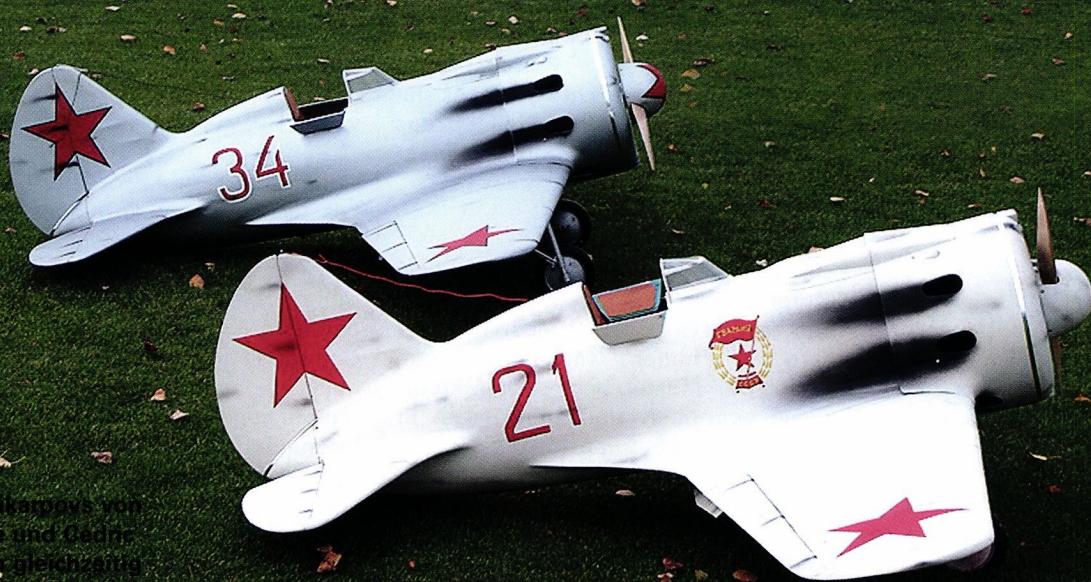
The tasks were divided up according to our respective professional skills: the landing gear went to Cédric, the mechanic; the structure to me, the carpenter; and we worked on the whole project together.
Because I love wood, white glue, and quirky airplanes, I could hardly wait to start building.
The construction method is varied: the wings, stabilizer, and tailplane are Oratex-coated structures; the fuselage and wing roots are made of fiber-reinforced balsa planking. The fuselage frames and some of the wings are made of 3- and 4-mm aviation-grade birch plywood. The ribs of the wings, rudder, and stabilizer are made of balsa wood, partially reinforced on both sides with 0.4-mm plywood. The engine cowling is made of fiberglass. The ribs at the wing roots cross the fuselage frames, forming a lightweight and very stable compartment in which the circuit boards for the retractable landing gear and the servo motors are installed.
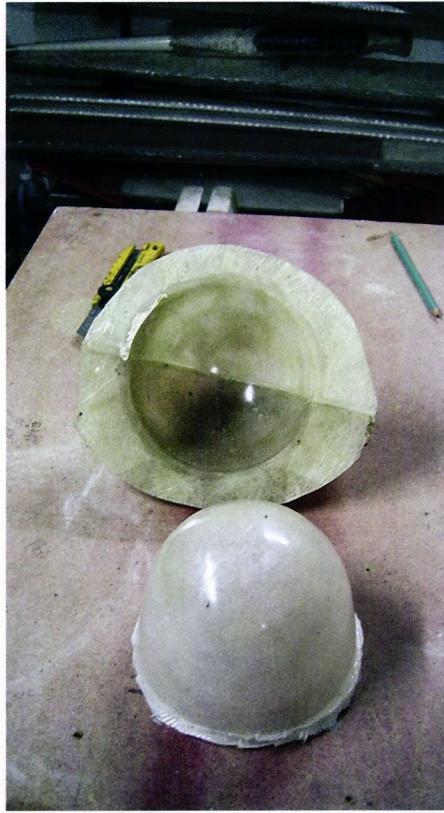
First, we set to work on the engine cowling. Since neither Cédric nor I had ever made fiberglass molds before, this was a huge challenge. The master model consists of wood and balsa laid out in a crisscross pattern. It includes the cover for the machine guns, their exhaust outlets, the mounting points for the exhaust ports and air intakes, as well as where the wing profiles meet the fuselage. The part looked good and was ultimately easy to build, even though it was tapered. That’s when the real doubts set in: How do we make a mold, and how do we then produce usable cowlings?
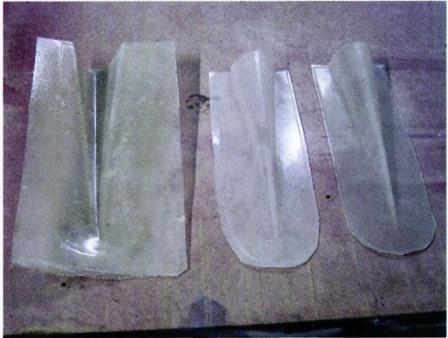
I found information online from Daniel Meylan, who provided a very helpful recommendation on his website
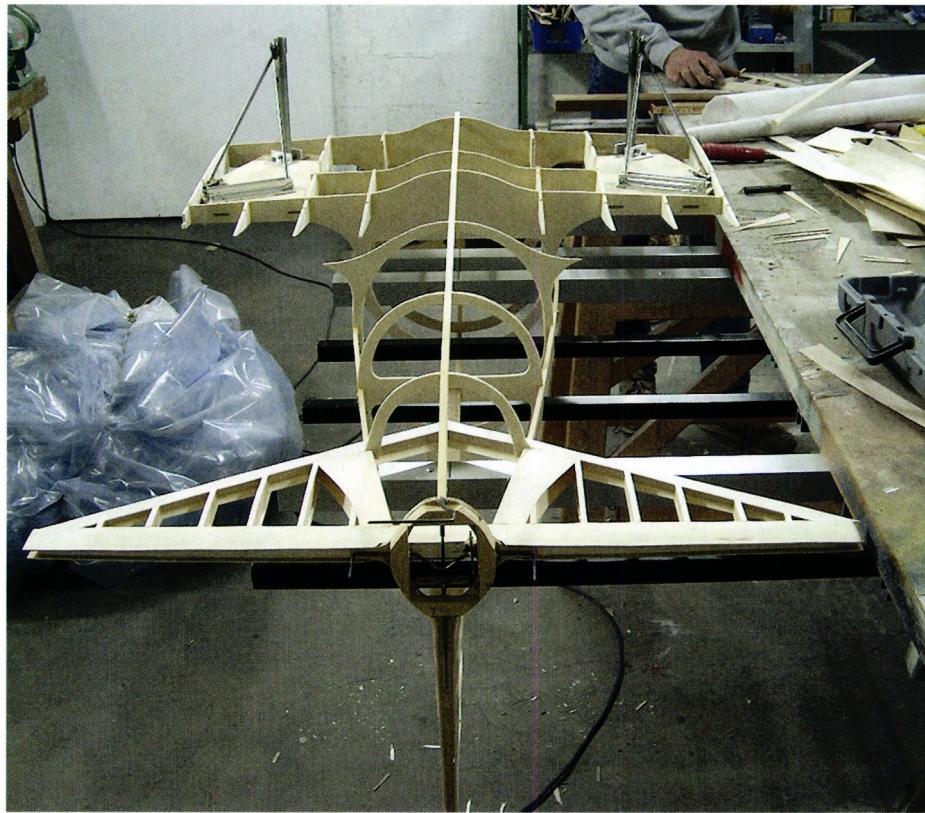
To assemble the aircraft while ensuring its geometry, I place aluminum profiles perpendicular to the workbench, extending beyond its edges. I screw the fuselage frames together, which immediately forms the aircraft. The frames are glued together with strips at their designated points. Both airplanes are assembled simultaneously. We can then already install the tail surfaces, the air brakes—which consist of two layers of 0.4 mm c.t.p.—the mounting plates for the servo motors, the landing gear, and even conduct tests if we wish.
Once everything is working, we begin to cover the structure with 3-mm balsa planks. Since there are still no straight lines, I’ll leave it to you to imagine how tedious this work is!
Because the frames feature Karman profiles, they are hollow and take shape on their own, so we didn’t have to worry about how to lay the planking.
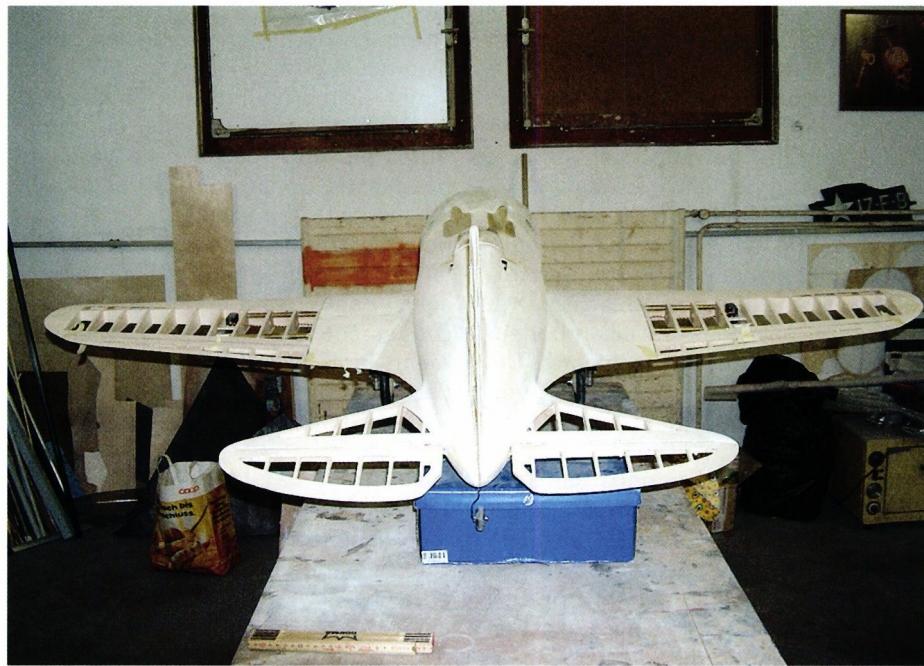
More than a year had passed by the time this work was completed. Now came the fateful moment of separating the aircraft from their stands and fitting the engine cowling to the fuselage. I hadn’t slept well the night before: Would it fit the fuselage? Were the wing roots at the right height?
That evening, we placed the cowlings on the fuselage, were happy, and drank a beer to celebrate! Afterward, we had to rethink everything from scratch.
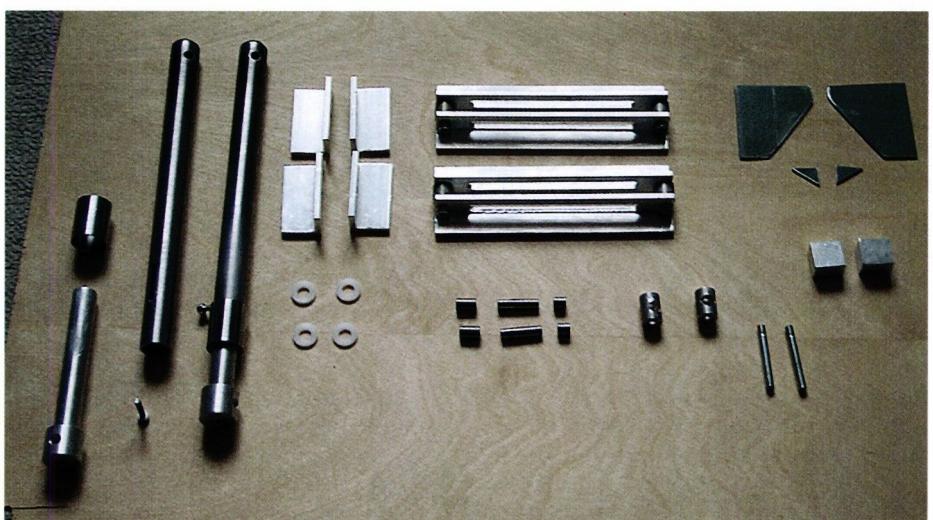
The landing gear is pyramid-shaped. Just like in a real airplane, it is driven by cables pulled by a servo. The locking mechanism in the “extended” position is operated by a spring-loaded mechanism that retracts the wheels in the event of a cable break. This landing gear was built entirely by Cédric.
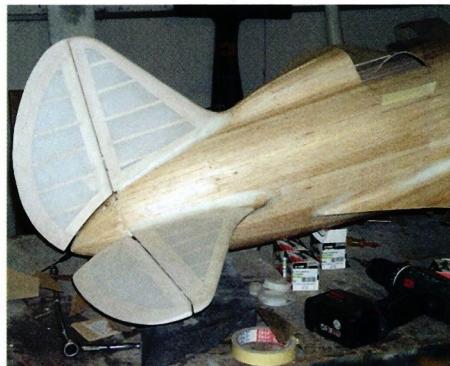
Like the wings, the tail surfaces consist of a balsa structure and are attached directly to the fuselage, with their struts integrated into the fuselage's final frame.
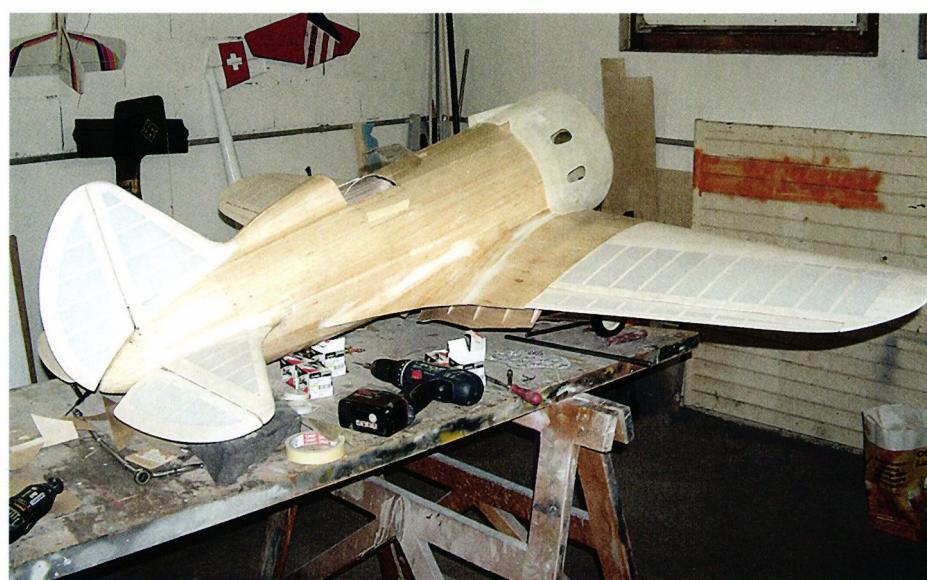
The wings were mounted on a frame with a 1° negative twist. The ailerons are firmly attached to the wings during assembly and are subsequently detached. The ribs containing the wing locking mechanism were reinforced with 0.4 mm c.t.p.
The cockpit canopy mold was made of 0.4 mm plywood glued to a 4 mm base plate. This created a sort of shell, which we filled with plaster. After applying several coats of very finely sanded wood finish, we achieved a smooth, texture-free surface, allowing us to begin shaping the canopy. To peel off the plastic film, I clamp it between two aluminum brackets on each side of the panel and use an industrial heat gun to warm the material. With two people working together, this is a breeze on such a small part.
All parts of the structure are strung, and the solid parts are coated with 25 gm² fiber material. Since I had never done this before, I was a little nervous about the task, but in the end, it wasn’t any harder than stringing the racket, nor did it take much more effort—provided it’s done right. Once again, a lot of sanding was required for the final coat of paint, in keeping with the chosen model: metallic gray for
Cédric, who is building a replica of one of collector Tim Wallis’s airplanes—which is being rebuilt in Russia and flies in New Zealand; dark white for mine, which is a replica of an aircraft used to defend the Leningrad Route and was flown by Captain Tsokolayev in 1942.
I use acrylic paint, which has the advantage of achieving precise color matching and doesn’t smell too bad. This is coated with a two-component varnish mixed with matte paste. The decals for Cédric’s plane are self-adhesive; mine are painted on.
Now all that was left was to install the fuel tank and the engine, run the cables for the retractable landing gear along with all the controls, and find solutions for all the little details that came to mind during the assembly of such a model.
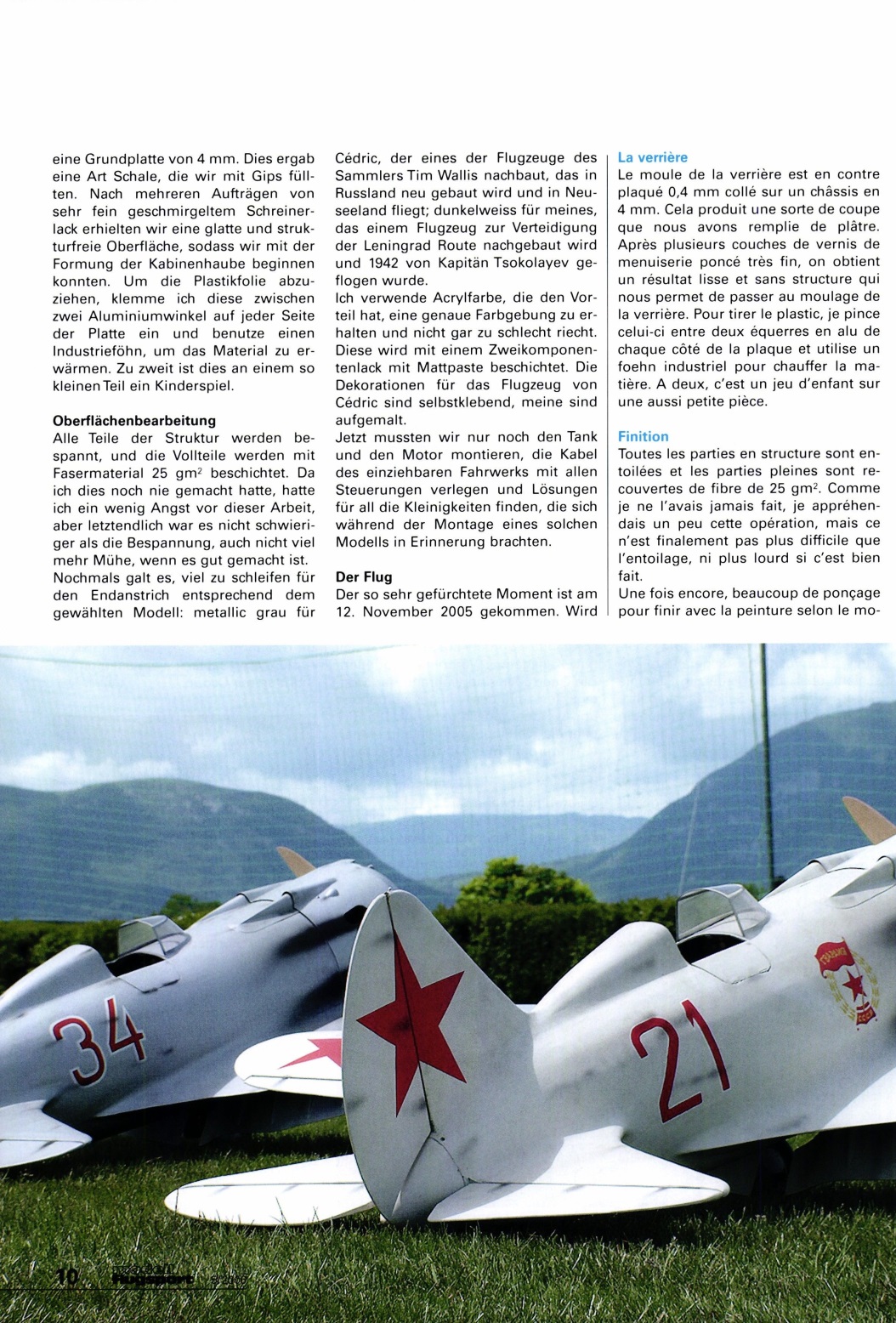
The moment we had all been dreading finally arrived on November 12, 2005. Would it fly, or wouldn't it? We adjusted the engines and tested the radio's operating range. Problems with interference were quickly resolved, and the two aircraft were finally ready for their maiden flight.
I have to make a note here. I always built “A” parts and “B” parts, which resulted in airplanes “A” and “B.” I chose aircraft “B” for myself, for the simple reason that “A flies first,” because Cédric is a better pilot than I am.
So Cédric went first (thanks, Cédric) at the end of the runway in Aigle.
Gradual throttle application, very high acceleration of the aircraft—which was kept on the ground as long as possible—and takeoff. To everyone’s amazement, the landing gear retracted immediately. The short fuselage makes the elevator very efficient, which was confirmed during the flight. We had far too much headroom, but Cédric kept everything fully under control with precise steering. The plane seemed fine, though very sensitive.
Landing without air brakes is difficult due to the excessively efficient elevator, but for a first flight, it went very well—and, most importantly, without any damage. Long live speed!
After reducing the elevator’s travel, I set out for my flight, feeling a bit nervous. Takeoff went without a hitch. With my settings, the flight was much smoother, though I had to be careful to maintain speed. I tested the landing gear. The landing went smoothly, aside from the engine idling too high, which meant I needed the entire length of the runway. In other words, it comes to a stop very quickly. In flight, this very special aircraft is truly wonderful.
For me, this was a big moment, because when you build an entire airplane, there are so many unknowns—it’s a relief to see that everything works.
In summary, I’d like to say that it was a wonderful experience, though I strongly advise beginners against it, as it remains a very sensitive aircraft.
| Polikarpov I 16 Type 24 / Polikarpov I 16 type 24 | ||
| Original/Original | Model/Modèle | |
| Wingspan/Envergure | 9.004 m | 2 m |
| Engine/Moteur | Shvestov M-63 | Titan-45 gasoline |
| Weight/Poids | 1,882 kg | 10.5 kg |
| Year of manufacture/Année de construction | 1939 | 2003–2005 |
| Profile/Profil | unknown/inconnu | NACA 2412 |


News from HEBU

YOU KNOW WHAT I MEAN? 125 YEARS OF THE SWISS AERO CLUB
 Emil Giezendanner

F3A EUROPEAN CHAMPIONSHIPS IN ST-MACAIRE, FRANCE
 Matthias Bosshard

What's New at Leomotion.com

52. 2026 ALPS CUP
Emil Giezendanner
PRIDE AND GOOD IDEAS
 Markus Nussbaumer

EURO CONTEST GLIDER ACRO TOUR AUSTRIA 2026

TEAM MANAGER "THIS" BOSSHARD
 Rodito Nussbaumer

HORIZON HOBBY/LEMACO NEWS: MICRO OV-10 BRONCO 645 MM BY E-FLITE

BY YOUTH, FOR YOUTH
Lorena Betschen
CORSAIR F4U – A WARBIRD WITH A MEMORABLE LOOK
Jürgen Rosenberger, Jürgen Prinz
SMALL, MODEL-LIKE SAILBOATS
Res Dauwalder
TRY-OUT DAY AT MFV WETTINGEN
Urs Keller
34th HAHNENMOOS ALPINE MODEL AIRPLANE CAMP
Res Dauwalder
SUMMER FUN 2026 AT MG USTER
Martin Wunderli
WELCOME, NEW MEMBER!
Andrea Bolliger
FREE FLIGHT IN THE MIDDLE OF SUMMER
Urs Muntwyler
THE PC-21 STORY
Emil Giezendanner
TWIN TOWN PARTNERSHIP
Wolfgang Voeller
ATOM, THE NEW DOUBLE-DECKER FROM CPLR
Matthias Bosshard
COUPE DES ALPES – OBSERVE AND LEARN
Rodito Nussbaumer
INSIGHTS INTO THE HISTORY OF SEAPLANES

NEWS FROM HEBU
 Julia Bucher

FROM 0 TO 100
Markus Nussbaumer
MEMORIES
Wolfgang Völler
NOS REGION – A HUB FOR ELECTRIC AVIATION
Emil Giezendanner
A SPECTACULAR F3A WORLD CUP IN THE PRINCIPALITY OF LIECHTENSTEIN
Emil Giezendanner
Have you almost forgotten about aircraft that take off and land vertically?
Emil Giezendanner