
MODEL AIRPLANE ENGINES and Their Development
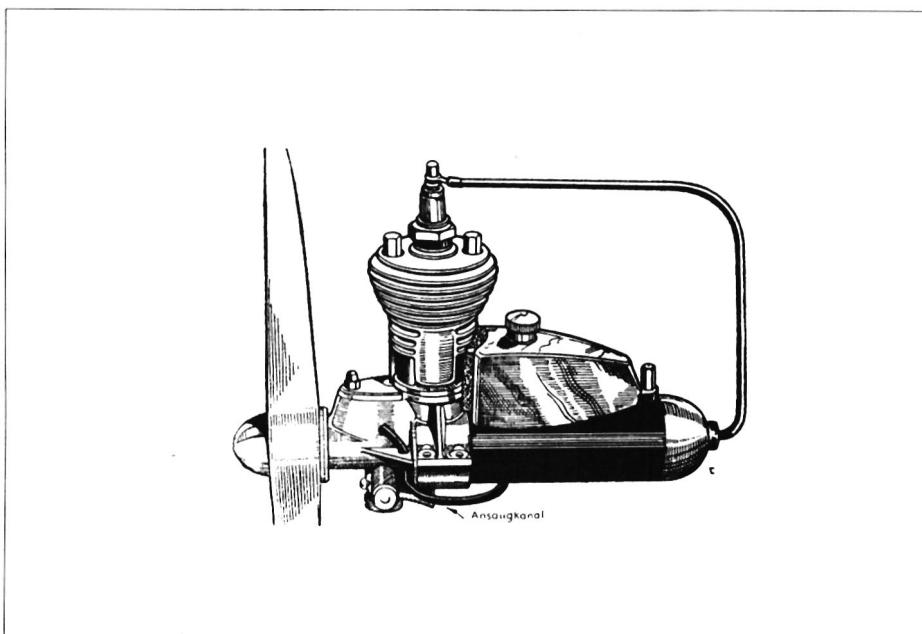
Among the lesser-known and most sought-after German engines are names such as Flottweg-Motor, Blankenmeister, Meier-Motor, and BHK. No owners of these engines could be located. If Felgiebel hadn’t described them, it’s likely that not even their names would have survived. In terms of design and visual appeal, the Flottweg is undoubtedly the one that most captivates collectors. It is one of those engines that was not produced simply by copying existing designs or using sand-casting methods. Similar to the early Kratmo engines or, for example, the German Riedl Diesel or Thusius engines, it features entirely unique and unconventional shapes. The Flottweg was already manufactured using sophisticated methods back then, and there must certainly still be such engines in basements or attics, because the housing was made using permanent-mold casting and Felgiebel mentions the Flottweg Engine Works in Munich. Judging by the technical effort involved, a rather impressive workshop must have been in the early stages of development at the time. The name is also interesting. Presumably, the builder chose the name to immediately highlight the engine’s capabilities. However, this term is used in Swabia and Bavaria—as well as in everyday slang—to describe a car that drives fast.
One of the problems was that, starting in 1939, the German dictator conscripted every efficiently operating factory into war service, causing companies like Argus Berlin to halt production of their model engines. The Flottweg was also constructed with an aluminum cylinder block, featuring a recessed gray-cast iron liner. The engine was one of the first German crankshaft-rotary-valve engines (along with the Ortus, which is a copy of the American Baby Cyclone). Its design was already quite streamlined. Despite its advanced design, it was not built with a very short stroke like the Thaler, but rather had a long stroke—a fact that, given the still-unresolved timing issues with rotary valves, likely explains why the engine’s rated speed is listed at only 4,000 rpm.
Particularly striking is the mounting of the cylinder with two tie rods (stud bolts). The streamlined yet harmonious arrangement of the ignition coil and the fuel tank is a delight to the eye of any engine enthusiast. One very interesting observation seems to be that the Flottweg engine is older than various authors have indicated. G. Schlaukötter states that it was built from 1940 to 1942. This is not entirely certain; although it is not yet listed in the first two editions of the Felgiebel book (1939–1940), it is included in the third edition from 1941.
The engine was seen at competitions during the war years but is said to be very rare. No collector is known to have one. It is certainly most likely that one could be found in the Munich area, where it originated. No owner of this engine could be located.
| Stroke | 24 mm |
| Bore | 22 mm |
| Displacement | 9 cc |
| Power | 0.2 PS |
| RPM | 4,000 rpm |
| Air screw diameter | 320 mm |
| Weight of the engine, including spark plug, ignition coil, capacitor, fuel tank, and air scoop | 500 g |
This engine is said to have been available in two different versions: one with a displacement of 5 ccm and one with 10.7 ccm. The first and second volumes of the Felgiebel book list the 10.7-ccm engine, and it is not until the subsequent editions that the 5-ccm engine is mentioned.
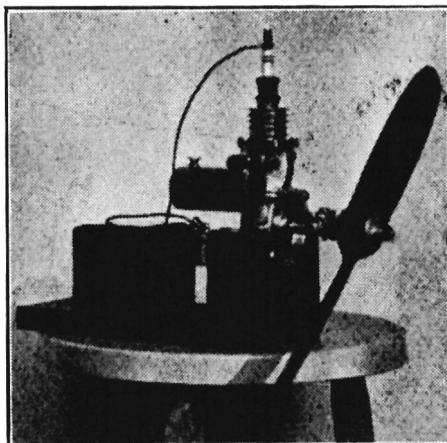
Blankenmeister built his engines in Mannheim. The engine featured a light-alloy crankcase that extended up to the cooling fins, so that the exhaust port was already integrated into this section. This design did not become standard practice until much later. The cooling fins were screwed onto the cylinder liner, which was secured to the crankcase with two set screws. The breaker is located on the crankshaft journal, mounted on the side. Conventional materials were used for the moving parts: gray cast iron for the pistons, chromium-nickel steel for the crankshaft, and bronze bearing shells. The valve train utilized the so-called 3-channel system, which is now referred to as a piston-controlled system. Here, too, we are dealing with a very rare engine that probably would never have become known if it weren’t for the Felgiebel.
The specifications for both engines are as follows:
| Displacement | 5 ccm | 10.7 cc |
| Bore | 19 mm | 24 mm |
| Stroke | 18 mm | 24 mm |
| Power at 5,500 rpm | 0.35 PS | |
| Power at 6,000 rpm | 0.18 PS | |
| Weight including ignition coil, fuel tank, and propeller: approx. | 260 g | 400 g |


News from HEBU

EURO CONTEST GLIDER ACRO TOUR AUSTRIA 2026

TEAM MANAGER "THIS" BOSSHARD
 Rodito Nussbaumer

YOU KNOW WHAT I MEAN? 125 YEARS OF THE SWISS AERO CLUB
 Emil Giezendanner

F3A EUROPEAN CHAMPIONSHIPS IN ST-MACAIRE, FRANCE
 Matthias Bosshard

HORIZON HOBBY/LEMACO NEWS: MICRO OV-10 BRONCO 645 MM BY E-FLITE

PRIDE AND GOOD IDEAS
 Markus Nussbaumer

BY YOUTH, FOR YOUTH
Lorena Betschen
34th HAHNENMOOS ALPINE MODEL AIRPLANE CAMP
Res Dauwalder
TRY-OUT DAY AT MFV WETTINGEN
Urs Keller
52. 2026 ALPS CUP
Emil Giezendanner
TWIN TOWN PARTNERSHIP
Wolfgang Voeller
ATOM, THE NEW DOUBLE-DECKER FROM CPLR
Matthias Bosshard
CORSAIR F4U – A WARBIRD WITH A MEMORABLE LOOK
Jürgen Rosenberger, Jürgen Prinz
SUMMER FUN 2026 AT MG USTER
Martin Wunderli
What's New at Leomotion.com

THE PC-21 STORY
Emil Giezendanner
COUPE DES ALPES – OBSERVE AND LEARN
Rodito Nussbaumer
SMALL, MODEL-LIKE SAILBOATS
Res Dauwalder
WELCOME, NEW MEMBER!
Andrea Bolliger
FREE FLIGHT IN THE MIDDLE OF SUMMER
Urs Muntwyler
INSIGHTS INTO THE HISTORY OF SEAPLANES

NEWS FROM HEBU
 Julia Bucher

FROM 0 TO 100
Markus Nussbaumer
MEMORIES
Wolfgang Völler
NOS REGION – A HUB FOR ELECTRIC AVIATION
Emil Giezendanner
DO YOU KNOW WHAT I MEAN IN THE LAND OF SMILES?
Emil Giezendanner
A SPECTACULAR F3A WORLD CUP IN THE PRINCIPALITY OF LIECHTENSTEIN
Emil Giezendanner