
Concept Study for High-Performance Glider Models
Based on my many years of experience in the design and construction of glider and motor glider models, I know that before beginning any work, one must first define the exact requirements. Anything else is pointless if one wants to achieve maximum performance within the desired flight envelope.
At first, I always tried to find the most suitable airfoil for my project by consulting various airfoil books, which wasn’t always easy and usually didn’t yield the desired performance. So I started developing my own airfoils early on. To test the airfoils, you need a corresponding wing mounted on a test airframe (fuselage). So I designed and built various wings for several fuselages in order to test the respective airfoils. This process included some failures, but as the saying goes, you learn from your mistakes. This conceptual study makes no scientific claims. It consists of empirically developed experiments that are now based on a wealth of know-how. One of the most important lessons learned is that even the most sophisticated model concept cannot compensate for pilot error, which leads directly to the first fundamental requirement. The models should be designed and engineered to be as forgiving of pilot errors as possible. A certain degree of inherent stability in all three axes is therefore required. Aerobatic pilots will rightly disagree with me here, as these models must be extremely maneuverable. However, such models are flown only by the best pilots, who have perfect control over their model in every conceivable flight attitude. Depending on the intended discipline, the requirements regarding strength, size, wing geometry, airfoil, and construction vary. To illustrate this, I have defined two different sets of requirements using two examples and established the corresponding model concepts. I designed, built, and flew the models that fit these specifications.
A light-wind glider with the lowest possible wing loading, docile flight characteristics, and good circling performance. The model should be able to exploit even small thermal pockets by flying tight circles in confined spaces, even near the ground. This model should be able to catch every breeze and convert it into altitude, especially near the ground.
A high-performance glider with excellent glide performance and stable circling characteristics. The model should not have too high a wing loading, yet still be able to search for and exploit thermals over a wide area at a comfortable speed. The model should be capable of operating at higher altitudes and over a wide area.
If you want to achieve maximum flight performance, these two sets of requirements cannot be met by a single model. All-around models are certainly versatile, but unfortunately they do not meet the high standards required in specific disciplines. For example, while an F3B model can compete alongside F3J models, it is clearly inferior to them (and vice versa), and so on. Based on these considerations, I had to develop two completely different model concepts and design and build the corresponding models.
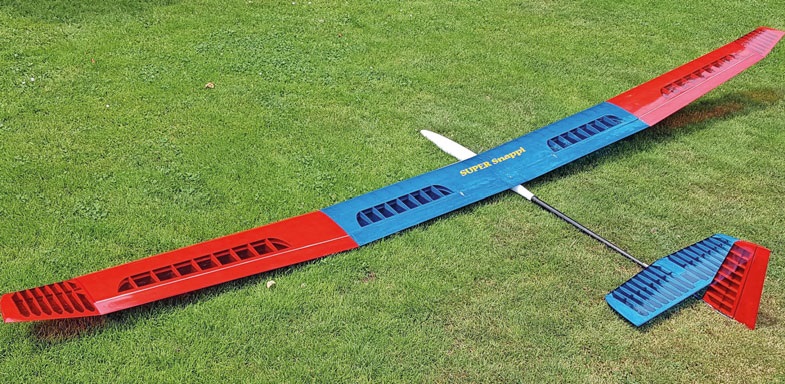
This model is designed as a pure glider for rubber-powered high-altitude launches. A launch altitude of approximately 100 m should be sufficient to find and exploit small thermal pockets nearby.
To achieve a relatively large wing area, a wing depth of 280 mm was chosen. However, to keep aerodynamic drag low, a relatively thin airfoil—just 8.8%—was selected for this wingspan. With this low airfoil thickness, the model can still make good progress even in a bit of wind without sacrificing sufficient lift. For such a lightweight model, a centerline camber of 2.11% is entirely sufficient. The UK 02 airfoil is a 0.8% thicker version of the UK 01, which continues to be used successfully for the RES competition model “Snappi.”
| Specifications: | Construction: Wings with 2 mm balsa ribs, 1.5 mm balsa skin, and foil covering |
| Wingspan: | 3900 mm |
| Weight: | 2,036 g |
| Wing area: | 106.1 dm² |
| Wing loading: | 19.19 g/dm² |
| Aspect ratio: | 14.34 |
| Profile: | UK 02/8.8 Thickness reserve 30% Centerline camber 2.11% |
| Tread depth (root): | 280 mm |
"The best of both worlds," was the thinking. Flight testing was supposed to confirm this.
The model fully meets my expectations and, therefore, the specified requirements. Its gliding performance is outstanding. Even on its maiden flight, the model flew with
This model has an electric motor with a folding propeller. The adjustable takeoff altitude allows you to locate and climb out of extensive thermal columns.
To achieve a higher flight speed, a relatively shallow wing depth of just 200 mm was chosen. A centerline camber of 2.71% ensures sufficient lift. However, the 13% thick airfoil generates slightly higher aerodynamic drag, which was deliberately accepted. Another advantage of the greater airfoil thickness is that the spar can be built significantly lighter while maintaining the same strength. On the one hand, due to their shallow airfoil depth of only 80 mm, the outer wing tips fall completely outside a favorable RE number range. The idea behind this is to treat the wing tips as folded-down winglets that are slightly extended and equipped with ailerons. The ailerons, now extended in this way, are intended to compensate for the agility lost around the longitudinal axis due to the higher aspect ratio and, together with the additional 4° V-shape, contribute to better stability in circular flight. This way, one gets, so to speak, the
| Specifications: | Wing construction: sandwich with 1.5 mm balsa planking and foil covering |
| Wingspan: | 4,160 mm |
| Weight: | 3,960 g |
| Wing area: | 66.3 dm² |
| Wing loading: | 59.73 g/dm² |
| Aspect ratio: | 26.20 |
| Tread pattern: | UK 17/13/-12/-12/-13, thickness reserve 37%, centerline camber 2.71%, tread depth (root): 200 mm |
| Motorization: | Kontronik in-runner motor, 60 A speed controller, 3S LiPo (4000 mAh), 17x10" folding propeller |

With a light push from the hand, it glides nearly 100 meters, which translates to a glide ratio of over 60. Precise measurements aren’t possible because they would have to be taken in absolutely still air, which practically never happens. The model flies relatively slowly, so even small thermal bubbles can be circled out without any trouble. Weak thermals are also easy to find and clearly visible with this model. The model flies flat circles on its own. For tighter circles, it needs a little sporadic assistance from the ailerons.
When launched from a launch line, it flies straight up into the sky, unfazed by a little crosswind, making it a true joy to fly.
With the UK 17 profile, I broke new ground. I had no prior experience with profiles this thick. So I decided to take a cautious approach. That wasn’t necessary with the Super Snappi, since I was already very familiar with the UK 2 profile. The maiden flight was launched by hand. To be on the safe side, I set the center of gravity well ahead of the thickness reserve (better safe than sorry). It’s clear that the EWD and the center of gravity are directly related to the profile’s thickness reserve and must therefore be precisely matched. That’s why a thorough flight test involving multiple flights is necessary. Since the Mega Snappi has a pendulum elevator, I proceed as follows: First, I set the EWD to $-1^\circ$ using the EWD scale. Then I set the center of gravity to 33% of the wing depth. I secure the wing leading edge to the fuselage and balance the model by adding weight as needed.
As expected, the model’s nose dropped significantly after shutting off the motor. So: Trim the model, test the airbrake (butterfly), land, and remove some lead (60 g for now). What I’ve already noticed: The ailerons work very well, and I’ve programmed 60% Expo for the elevator.
So, restart, engine off—the model still noses down. Remove another 60 g of weight and take off again. Now the model flies smoothly along its path without needing any further trimming. Now for the ultimate center-of-gravity test: pitch it at a $45^\circ$ angle, let go, and wait to see how the model reacts. It slowly recovers and transitions into a gentle climb... success.
The model circles beautifully without any stress. A wonderfully elegant flight pattern. In the speed setting, the model picks up speed significantly without losing much altitude. It’s really impressive how it converts that speed back into altitude.
Both models fully meet the expectations set for them with regard to the defined objectives. Neither model could even come close to achieving the goals of the other. From this perspective, there simply is no such thing as an all-around model that can do everything in the high-performance range. However, while all-around models can do a lot, they unfortunately cannot excel at everything. In the individual specialized disciplines, the corresponding high-performance models are clearly superior.
All-around models are everyday models and are absolutely justified for this purpose. You can take them anywhere and fly them in almost all weather conditions—just with certain limitations. For some people, this is completely sufficient.
One more note on costs. I built the two models for a total of about 500 Swiss francs (cost of materials). The Super Snappi would cost at least CHF 1,300 (unassembled) on the market, and the Mega Snappi at least CHF 2,200 (unassembled). Building them yourself is definitely worth it. Of course, it’s not for everyone, but it’s certainly worth considering.


News from HEBU

EURO CONTEST GLIDER ACRO TOUR AUSTRIA 2026

TEAM MANAGER "THIS" BOSSHARD
 Rodito Nussbaumer

YOU KNOW WHAT I MEAN? 125 YEARS OF THE SWISS AERO CLUB
 Emil Giezendanner

F3A EUROPEAN CHAMPIONSHIPS IN ST-MACAIRE, FRANCE
 Matthias Bosshard

HORIZON HOBBY/LEMACO NEWS: MICRO OV-10 BRONCO 645 MM BY E-FLITE

PRIDE AND GOOD IDEAS
 Markus Nussbaumer

34th HAHNENMOOS ALPINE MODEL AIRPLANE CAMP
Res Dauwalder
TRY-OUT DAY AT MFV WETTINGEN
Urs Keller
52. 2026 ALPS CUP
Emil Giezendanner
BY YOUTH, FOR YOUTH
Lorena Betschen
ATOM, THE NEW DOUBLE-DECKER FROM CPLR
Matthias Bosshard
CORSAIR F4U – A WARBIRD WITH A MEMORABLE LOOK
Jürgen Rosenberger, Jürgen Prinz
SUMMER FUN 2026 AT MG USTER
Martin Wunderli
What's New at Leomotion.com

THE PC-21 STORY
Emil Giezendanner
COUPE DES ALPES – OBSERVE AND LEARN
Rodito Nussbaumer
TWIN TOWN PARTNERSHIP
Wolfgang Voeller
SMALL, MODEL-LIKE SAILBOATS
Res Dauwalder
WELCOME, NEW MEMBER!
Andrea Bolliger
FREE FLIGHT IN THE MIDDLE OF SUMMER
Urs Muntwyler
INSIGHTS INTO THE HISTORY OF SEAPLANES

NEWS FROM HEBU
 Julia Bucher

FROM 0 TO 100
Markus Nussbaumer
MEMORIES
Wolfgang Völler
NOS REGION – A HUB FOR ELECTRIC AVIATION
Emil Giezendanner
DO YOU KNOW WHAT I MEAN IN THE LAND OF SMILES?
Emil Giezendanner
A SPECTACULAR F3A WORLD CUP IN THE PRINCIPALITY OF LIECHTENSTEIN
Emil Giezendanner