
You don't have to be an artist
The F3M class (formerly known as F3AX) is not very common in Switzerland. It involves aerobatics with large models having a wingspan of at least 2.1 m (1.8 m for biplanes) and is listed as a provisional class in the FAI Sporting Code. A few friendly competitions have taken place in Switzerland, particularly in Sierre, where the Alpine Competition was held for several consecutive years, though without incorporating the aerobatic programs prescribed by the FAI.
The situation continues to evolve, as the club in Bulle is now organizing an international competition this year from June 27 to 29. The three performance levels (beginner, national, and international) will be represented by approximately 35 pilots from 6 different countries. This article was written with the intention of raising awareness of F3M aerobatics in our country.
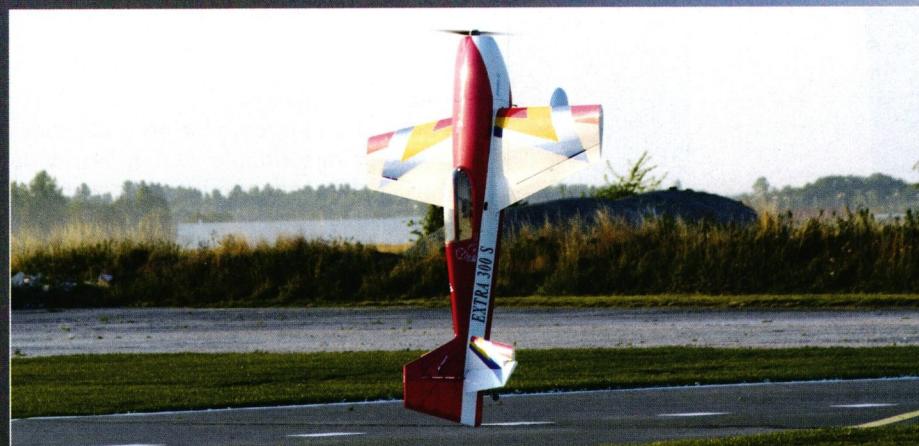
A motivated model airplane pilot—boy or girl (yes, really!)—who wants to advance in recreational flying and is willing to spend a little time training in aerobatics under competitive conditions... You don’t have to be a master pilot to try your hand at aerobatics. If you can fly a roll, a loop, and a turn, you’re already ready to start perfecting these maneuvers: the path is open to you. This path may be long, but the satisfaction you gain along the way will help you persevere.
The minimum wingspan for starting aerobatics with large models is 2.10 m (1.8 m for biplanes). It’s absolutely not necessary to have the largest possible model—or even the most expensive equipment—to perform beautiful flights. It’s the assembly, the adjustments, and your piloting that make all the difference. Don’t have a model yet? Approach this with your budget and confidence in mind, but stay reasonable.
Experience shows that a model’s lifespan is directly proportional to the length of the pilot’s and the builder’s beards (which, by the way, are often the same person…). Fly a medium-sized model for a year or two, and you’ll be able to perfect your knowledge of VGM. It’s easier to move up from 1.80 m to 2.20 m than to jump straight to 2.50 m or 3 m!
I often hear people say, “A large model is easier to fly.” This is a one-sided generalization. It’s true that with a well-built and properly tuned model, flying shouldn’t pose any problems. Nevertheless, size can make a big difference, and landings are the tricky part. Dimensions and weight are important, and it’s advisable to avoid the low edges of the runway if you want to keep your model in good condition… In summary: Make your choice to the best of your knowledge and judgment so that you can enjoy it. Never assume that a larger model will earn you more points in a competition!
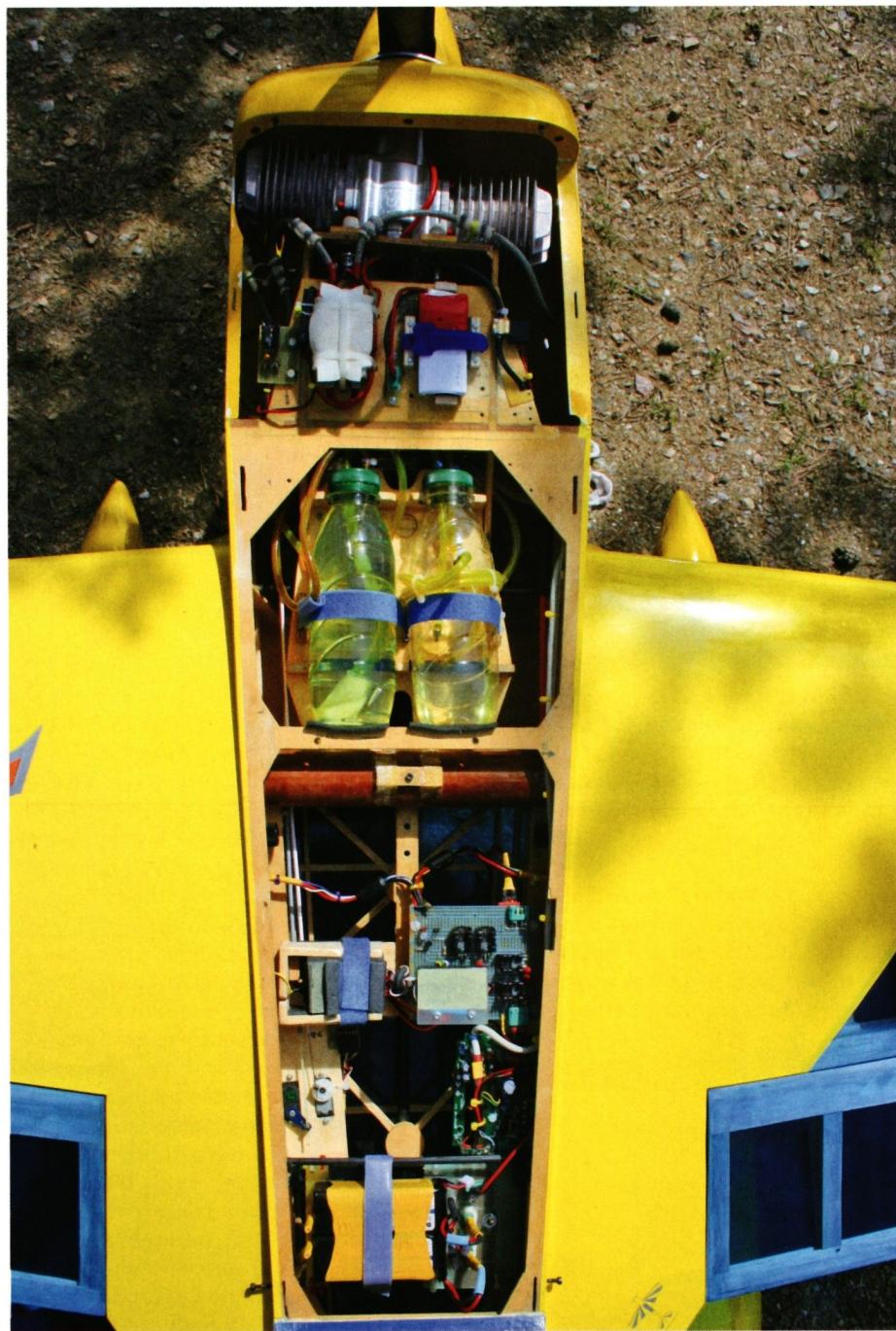
As for the engine, it’s the same as with the model: Be reasonable. Yes, you need power… But you need an airplane for aerobatics, not a rocket! Excessive power is difficult to control. On a smooth flight path, this isn’t a problem, but if the path is even slightly irregular, the model will veer off course much more quickly. To put it simply, if your model can perform a vertical roll and then fly a short distance in a straight line, that’s enough.
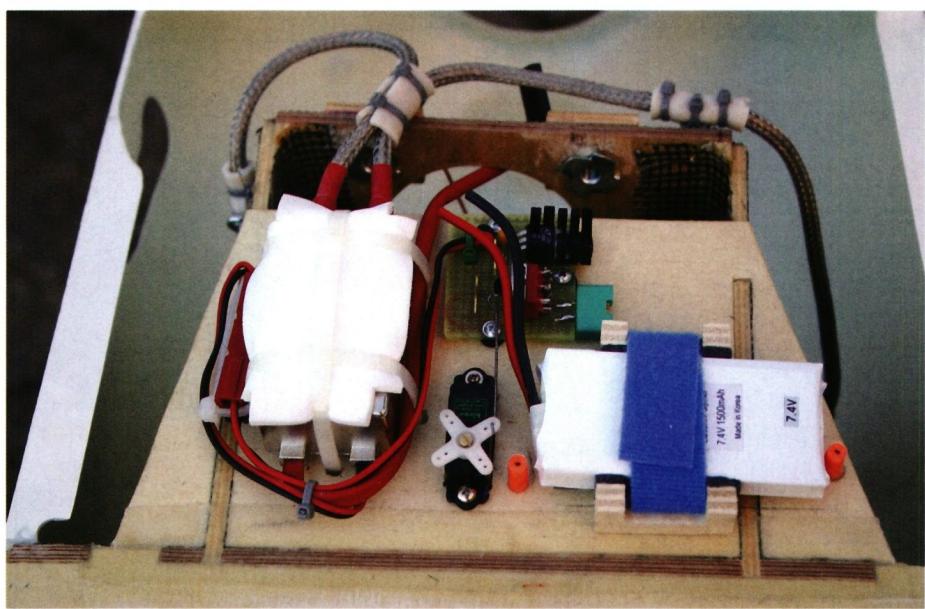
As for the radio equipment, leave out anything unnecessary. Digital servos aren’t a must. You should save a little money, especially considering trips to competitions and the purchase of your next model. A dual power supply is the only equipment required for models under 2.30 m. Beyond that, you can start thinking about using two receivers, although this isn’t a necessity—especially since this option isn’t currently available at 2.4 GHz.
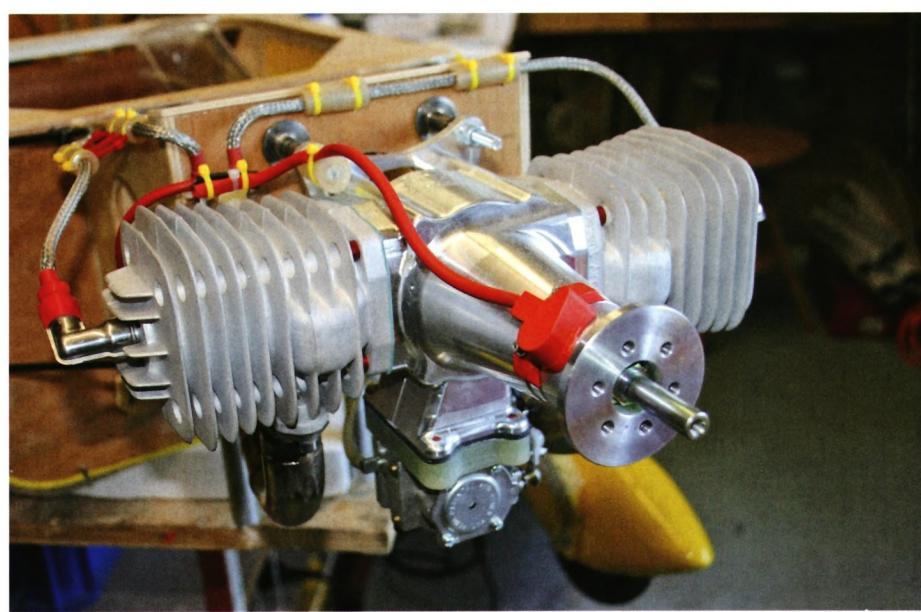
When starting out in the F3M category, you should budget about 2,500 francs... This amount is sufficient to purchase a model approximately 2.30 m long with a 50-cm³ engine, a dual power supply, and appropriate radio equipment. For a larger model, the costs rise very quickly.
First, it’s a good idea to download the regulations from the Internet. For the Inter category, they can be found on the FAI website (www.fai.org). For the Espoir (Beginner) and National categories, since there are no Swiss regulations, you can download the French (http://www.ffam.asso.fr/) or German (http://www.dmfv.de/pages/eac/index2
.htm) versions. These documents answer many questions.
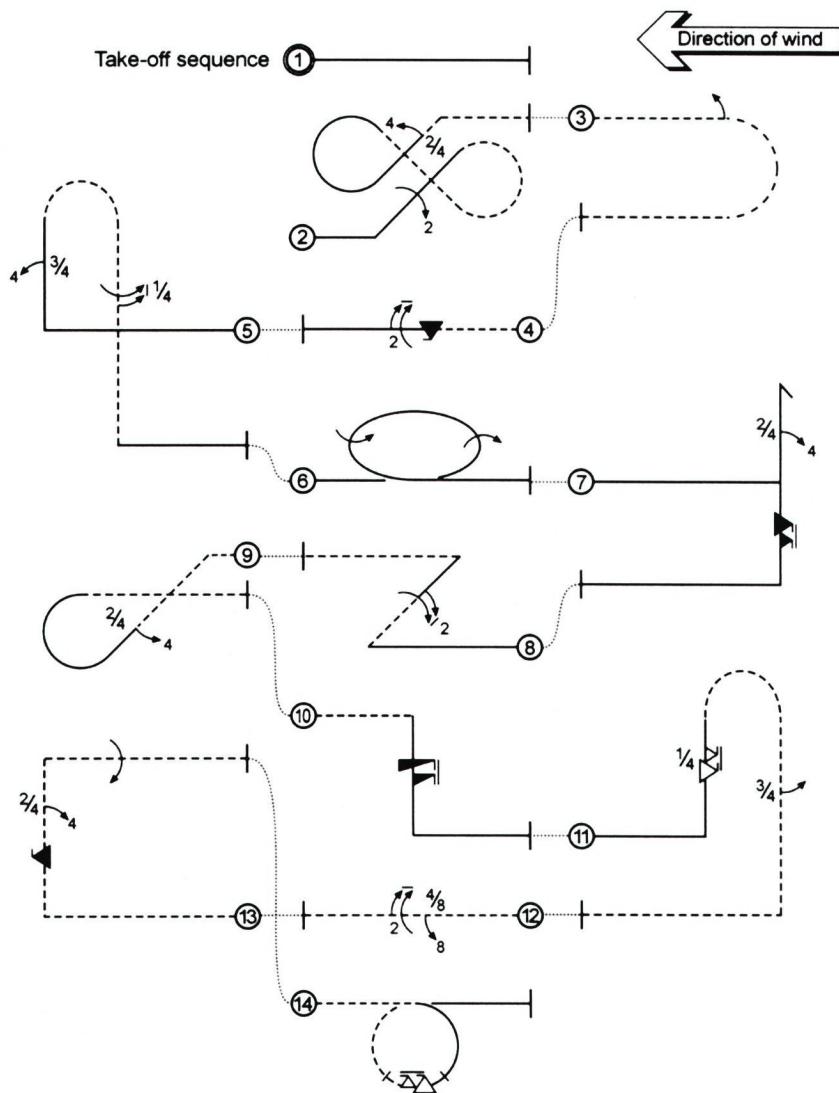
They also contain “l’aresti,” i.e., the symbolic representation of the standard programs and a textual description of the figures. On the ground, mark the boundaries of the area and the center line. It is not absolutely necessary to draw the lines on the ground. Distant but distinct landmarks (a tree, a house) are just right. When flying, everyone does it their own way; however, it seems that flying each figure in the program independently and then combining them yields the best results. Key points include the arrangement of the figures (height, depth, and centering for central figures) as well as the quality of the exits (horizontal flight path). It’s not necessary to wait for perfect flights to enter a competition. This is all the more true because you can be pretty sure that what you’re aiming for isn’t exactly what’s required, unless you receive extremely effective advice from an experienced pilot.
In the skies above Gruyère.
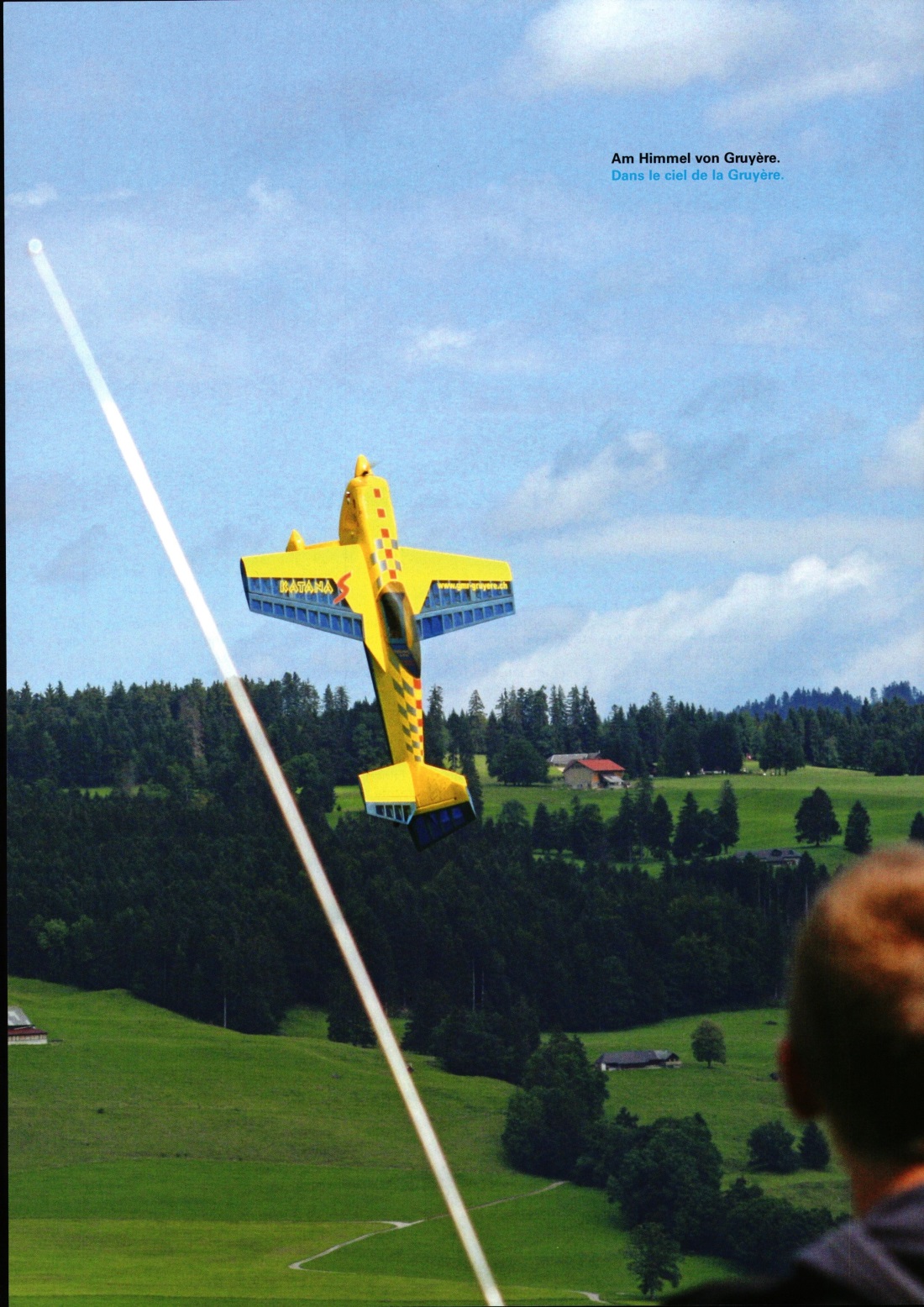
How does it work? Bring your helper, if you have one. If not, you’ll have no trouble finding one right there. Take a look at the order of events and get your plane ready right away (assembly, fueling, etc.). There’s nothing worse than having to run for a tool to fix an air bubble when your plane is already in the preparation bay. When the runway marshal calls your name, pick up your RC transmitter from the control room, your helper from the refreshment stand, and your plane from the parking lot, then bring everything to the preparation box. Check that the RC system is working, and use these last moments before the flight to focus your concentration to the maximum. If a problem arises, let your runway marshal know in a timely manner. With the jury’s approval, you’ll likely be able to repeat your flight once everyone else has flown.
Finally, the moment you’ve been eagerly awaiting has arrived. The runway marshal calls you to the starting line. Start the engine. The assistant will take the model to the start of the runway. Walk to the control point and position yourself well in front of the centerline. It never hurts to check the boundaries of the area... At the judges’ signal, hop on and go! Listen to your assistant during the flight! He has a much better view of the layout than you do. In particular, he’ll announce the maneuvers to you, divide up the area, and tell you which direction to head next. If there’s enough time, he can also help you execute the maneuvers (verbally, of course).
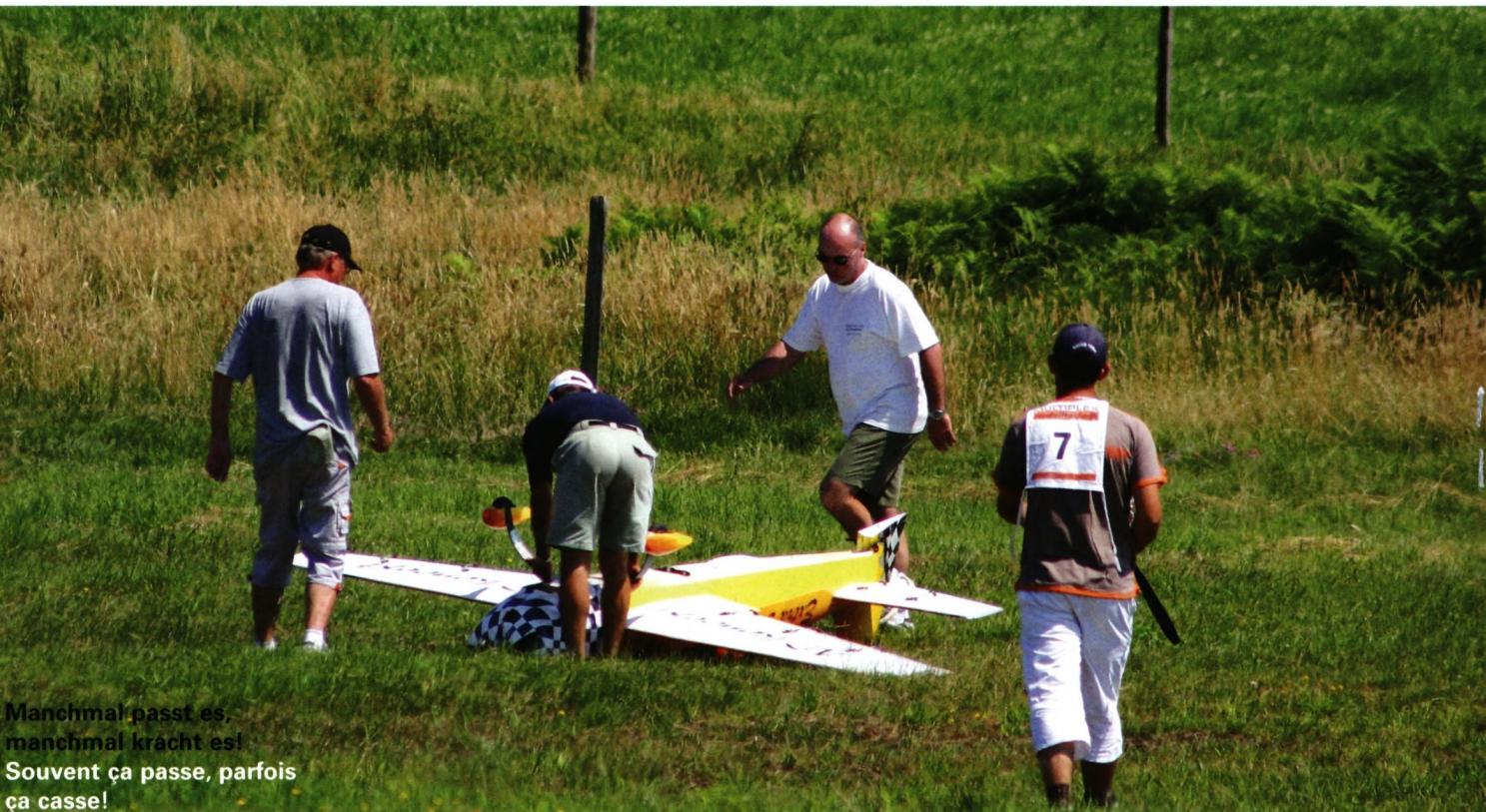
A few minutes later—and in the vast majority of cases—the model will be back on the runway; all the better if it’s still in one piece. Turn off the motor at the end of the runway. For obvious safety reasons, it’s prohibited to use the motor to bring the model back. Let your assistant retrieve the aircraft—you have much better things to do: discussing with the judges, who won’t let up until they’ve analyzed your mistakes. They’ll explain them to you and offer appropriate advice. Discuss your flight with your assistant and/or the pilots who observed your maneuvers. The next flight will follow a predetermined, unknown program. This will be communicated to you a few tens of minutes before the flight. Prepare immediately. It’s best to write down the description and memorize it. Your helper should do the same! Memorize landmarks for the model’s position as it flies from one maneuver to the next. If you have any doubts about the maneuver to be performed, ask a fellow competitor.
Practice the routine with a small balsa wood model on a stick; this makes memorization easier and helps you identify the key points for positioning the maneuvers. No, you’re not making a fool of yourself—all pilots do this! This preparation must be done with your spotter so that you’re both on the same page when it’s time to fly. Some pilots prefer to have the routine written down in text form so they can see exactly the instructions they want in front of them. If the routine includes maneuvers you’ve never done before, run through them in your head as if you were actually flying. Think about the model’s position and how to handle the control sticks; prepare for it physically just as you would for a familiar routine. Before the first competitor takes off, there’s a briefing with the judges and the pilots to ensure there’s absolutely no doubt about what’s to be performed during the flight. Even more so than for the familiar routine, it’s important to watch the flights of the competitors who start first (unless, of course, you’re the first to fly).
You can confirm or adjust your choice of rotation direction based on the wind and learn from any mistakes you’ve identified.
After two known and two unknown flights comes the freestyle. For the audience, this is the most spectacular part of the competition. This flight set to music is not mandatory for participants in the beginner category. All pilots who choose to participate, regardless of category, are ranked together. You may not be at the same level as the best pilots, but don’t hesitate to show what you’ve prepared. The main thing is simply to avoid performing maneuvers that you haven’t mastered yet. The key word is “safety.”
Yes, you're still wrapping up your first competition, and you're surprised to find yourself already thinking about the next one! From now on, you know where your strengths and weaknesses lie. So now you know how to move forward successfully...
| 5L.1.3. General Characteristics of a large R/C Aerobatic Power Model Aircraft | |
| Minimum overall span for monoplanes | 2,1 m |
| Minimum overall span for biplanes | 1,8 m |
| Maximum flying weight without fuel | 20 kg |


News from HEBU

EURO CONTEST GLIDER ACRO TOUR AUSTRIA 2026

TEAM MANAGER "THIS" BOSSHARD
 Rodito Nussbaumer

YOU KNOW WHAT I MEAN? 125 YEARS OF THE SWISS AERO CLUB
 Emil Giezendanner

F3A EUROPEAN CHAMPIONSHIPS IN ST-MACAIRE, FRANCE
 Matthias Bosshard

HORIZON HOBBY/LEMACO NEWS: MICRO OV-10 BRONCO 645 MM BY E-FLITE

PRIDE AND GOOD IDEAS
 Markus Nussbaumer

BY YOUTH, FOR YOUTH
Lorena Betschen
34th HAHNENMOOS ALPINE MODEL AIRPLANE CAMP
Res Dauwalder
TRY-OUT DAY AT MFV WETTINGEN
Urs Keller
52. 2026 ALPS CUP
Emil Giezendanner
TWIN TOWN PARTNERSHIP
Wolfgang Voeller
ATOM, THE NEW DOUBLE-DECKER FROM CPLR
Matthias Bosshard
CORSAIR F4U – A WARBIRD WITH A MEMORABLE LOOK
Jürgen Rosenberger, Jürgen Prinz
SUMMER FUN 2026 AT MG USTER
Martin Wunderli
What's New at Leomotion.com

THE PC-21 STORY
Emil Giezendanner
COUPE DES ALPES – OBSERVE AND LEARN
Rodito Nussbaumer
SMALL, MODEL-LIKE SAILBOATS
Res Dauwalder
WELCOME, NEW MEMBER!
Andrea Bolliger
FREE FLIGHT IN THE MIDDLE OF SUMMER
Urs Muntwyler
INSIGHTS INTO THE HISTORY OF SEAPLANES

NEWS FROM HEBU
 Julia Bucher

FROM 0 TO 100
Markus Nussbaumer
MEMORIES
Wolfgang Völler
NOS REGION – A HUB FOR ELECTRIC AVIATION
Emil Giezendanner
DO YOU KNOW WHAT I MEAN IN THE LAND OF SMILES?
Emil Giezendanner
A SPECTACULAR F3A WORLD CUP IN THE PRINCIPALITY OF LIECHTENSTEIN
Emil Giezendanner