
8th Swiss Electric Flight Nationales 2006 in Breitenbach BL
This was the 8th time these championships in the F5C class for electric helicopters were held in Switzerland. The event took place as part of the Swiss Electric Flight Nationales and was organized by MG-Breitenbach BL. We gathered for the event on October 29, 2006, at the model airfield in Breitenbach in the Laufental region of Basel.
This class has become increasingly controversial; starting this year, the focus has been on promoting mini helicopters, which, according to FAI regulations, are limited to a rotor diameter of 1.15 m. In the previously open class, where larger rotor diameters are also permitted, we ultimately had five participants on the field, after two had to withdraw due to defects in their models. In the Mini category, no entries were received in response to the online announcement on the Silent Wings homepage.
Due to the ups and downs in this class, the F5C program from 2003 was once again put into use. It consists of 22 maneuvers—10 hovering maneuvers, 10 flight maneuvers, and a mandatory landing (see table). The maneuvers are assigned various factors ranging from 1 to 4, which serve as multipliers in the scoring. This program also forms the basis for the Mini class, where the foundation of the competition is laid in two preliminary rounds. In an open freestyle program, which may optionally be accompanied by music, the day’s winner is determined based on the overall score. The first competition of this kind was held on September 23, 2006, in Pfäffikon, ZH, with four participants.
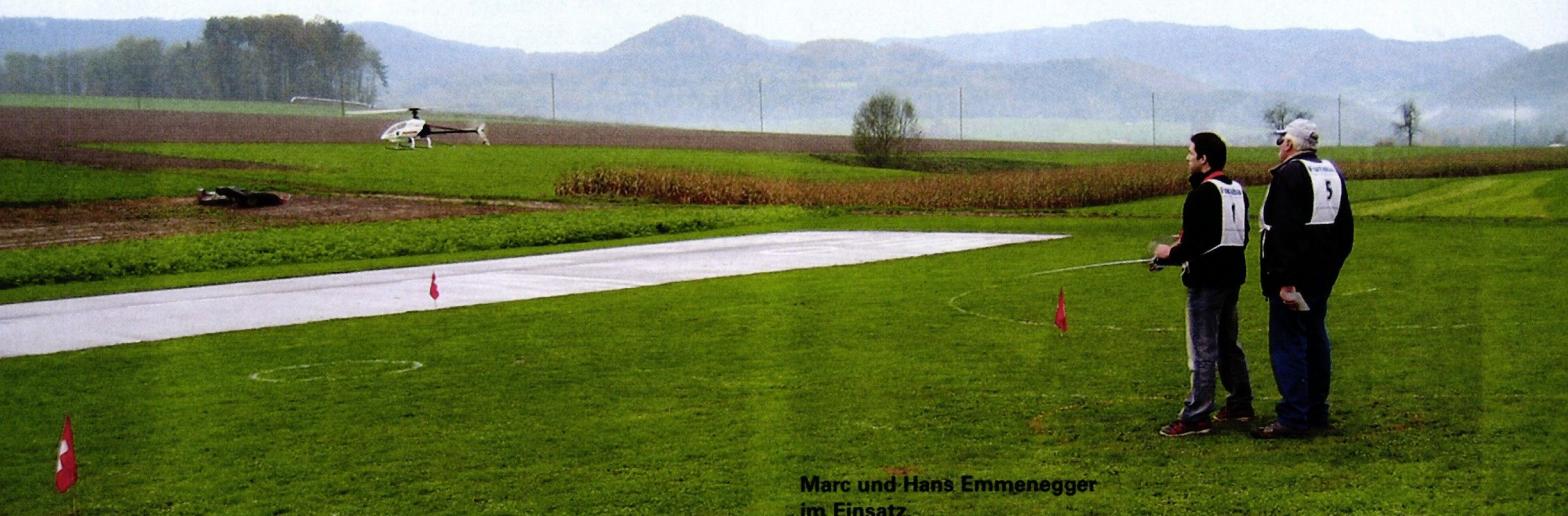
According to the announcement, the start time for the F5A class was set for 9:00 a.m.; this is a combined F5A/F5C competition. Rain delayed the event, but at around 9:15 a.m., Heiner Borer, chairman of the organizing committee, welcomed the participants and guests in attendance. Competition directors Emil Giezendanner and Walter Heller provided information about the competitions, and the judges and jury in attendance were introduced. In a change to the program, the helicopters were given priority, and after the rain let up, we began the first round at approximately 9:45 a.m. The setup allowed for preparation under a tent; the light rain was tolerated, but not particularly appreciated by the participants for their helicopters! With the five pilots in attendance, the competition proceeded very efficiently; there were no restrictions for the electric models during lunchtime, so by then we were able to complete two rounds in the helicopter class and add the F5A class as well. In the meantime, the rain had eased off or stopped altogether. The standings among the five participants were already taking shape by then. Despite the modest number of participants in today’s two categories, MG-Breitenbach didn’t miss the opportunity to offer a full spread from the “field kitchen.” Yes, they really spoiled us on this cold and damp fall day. After this delicious lunch, a third round was held, and everyone was eager to fly. Once again, Hans Emmenegger held the top spot, followed by Markus Rohrer and Seppi Gisler. In 4th and 5th place were Andy Kessler and Marc Emmenegger, who was competing for the first time. I’d like to give special mention to his performance—he started flying helicopters around June and has already mastered eight maneuvers from this program. These weren’t exactly the easiest maneuvers—they included a roll, a double roll, and a turn with a half-roll. Bravo!
Around 4:00 p.m., the event concluded with three rounds in each class, and we were able to proceed to the awards ceremony (see results). Special thanks go to MG-Breitenbach for the flawless organization and excellent facilities. Our thanks also go to the judges; in the F5C class, they were Hansruedi Lüthi and Markus Witschi. He was one of the newcomers and scored points in a helicopter competition for the first time. And so, a wonderful event came to an end for us; unfortunately, it remains to be seen whether it will continue. Whether the Mini class will gain traction among electric helicopters remains to be seen, though Emil Giezendanner is firmly convinced it will. It’s understandable that organizers don’t want to proceed with electric helicopters exactly as they do in the F3C-FAI class. New ideas are needed and must be implemented—or is the electric class in danger? Emil is grateful for suggestions and ideas backed by active support; he’s happy to receive them as part of the Electric Commission and in his capacity as a CIAM representative. By doing so, you’ll help promote electric helicopters in competitions for years to come.
| Figure No. List 1: Hovering Figures | K-factor | |
|---|---|---|
| 101 | Sideways Hover | 2 |
| 102 | Hovering Circle | 2 |
| 103 | Tail circle | 2 |
| 104 | Hover Flight M | 3 |
| 105 | Vertical Triangle (5 m) | 3 |
| 106 | Circles (formerly Nodes) | 3 |
| 107 | Pirouette | 3 |
| 108 | 4-Point Pirouette | 4 |
| 109 | Nose walk | 4 |
| 110 | Vertical Rectangle (4 m) | 4 |
| Figure No. List 2: Flight Figures | K-factor | |
|---|---|---|
| 201 | 180-Degree Stall Turn | 2 |
| 202 | Looping | 2 |
| 203 | Horizontal Circle | 2 |
| 204 | Pushover | 3 |
| 205 | Role | 3 |
| 206 | 540-degree turn | 3 |
| 207 | 180-degree turn with a half roll forward | 4 |
| 208 | Downward swing | 4 |
| 209 | 2 consecutive rolls | 4 |
| 210 | Half roll | 4 |
Select 7 of the 22 figures; the 8th figure must be one of the two landings, which counts as a compulsory figure. Three figures must be selected from the hovering program and three from the flight figures program; a seventh may be selected from either set of figures.
Note: The figures must be chosen so that the sum of the K-factors does not exceed 27!
| Figure No. List 3: Landing | K-factor | |
|---|---|---|
| 301 | Landing with a 180-degree turn | 1 |
| 302 | Autorotation with a 180-degree turn | 2 |
Non-experts still confuse electric aerobatics (F5A) with F3A aerobatics. Yet there are very significant differences between the two. First, electric aerobatic models (outdoor) must not weigh more than 3 kg, while F3A models are allowed to weigh up to 5 kg without fuel. 3-kilogram electric models must therefore be built to be very light and delicate. A good current example is the “Inspire” model by Swiss champion Pirmin Jund (see also Market Info). This lightweight design also creates entirely different conditions for the aerobatics themselves: The entire routine is flown within a very narrow, cube-shaped box whose edge length corresponds to the length of a soccer field. The maneuvers can be chosen freely. Pilots who choose more difficult maneuvers fly fewer of them, and vice versa. Turn maneuvers are not defined but are taken into account in the overall impression. The program is performed not only in the F3A style—from left to right and from right to left—but also diagonally or perpendicular to this axis in 3D style. The finale is accompanied by music. By the way: Unlike in F3A aerobatics, combustion engines may not be used in F5A.
Walter Heller and Emil Ch. Giezendanner
| F5A Aerobatics | |||
|---|---|---|---|
| 1 | Pirmin Jund | Zugerland | 2155 |
| 2 | Hugo Peyer | Reuss Valley | 2122 |
| 3 | Matthias Engeler | Breitenbach | 1948 |
| 4 | Felix Andres | Breitenbach | 1677 |
| 5 | Michel Hauser | Breitenbach | 1529 |
| F5B Gliding | |||
|---|---|---|---|
| 1 | Rueb Guntmar | GER | 2989.05 |
| 2 | Heiko Greiner | GER | 2,988.06 |
| 3 | Markus Moeckli | SUI | 2,967.96 |
| 4 | Marco Cantoni | SUI | 2,946.06 |
| 5 | Remo Frattini | SUI | 2,903.01 |
| 6 | Pierre Bossard | SUI | 2,891.31 |
| 7 | Thomas Waeckerlin | SUI | 2,864.32 |
| 8 | Claude Beguin | FRA | 2,454.1 |
| 9 | Piermario Cavaggioni | ITA | 376.49 |
| 10 | Mossa, Alessandro | ITA | 275.48 |
| Helicopter (F5C) | |||
|---|---|---|---|
| 1 | Hans Emmenegger | U. Aaretal | 2000 |
| 2 | Markus Rohrer | Sursee | 1869 |
| 3 | Josef Gisler | Schwyz/Uri | 1764 |
| 4 | Andy Kessler | Möhlin | 1723 |
| 5 | Marc Emmenegger | Wohlen | 1320 |
Jury: Heiner Borer, Felix Andres, Emil Giezendanner


News from HEBU

YOU KNOW WHAT I MEAN? 125 YEARS OF THE SWISS AERO CLUB
 Emil Giezendanner

F3A EUROPEAN CHAMPIONSHIPS IN ST-MACAIRE, FRANCE
 Matthias Bosshard

What's New at Leomotion.com

52. 2026 ALPS CUP
Emil Giezendanner
PRIDE AND GOOD IDEAS
 Markus Nussbaumer

EURO CONTEST GLIDER ACRO TOUR AUSTRIA 2026

TEAM MANAGER "THIS" BOSSHARD
 Rodito Nussbaumer

HORIZON HOBBY/LEMACO NEWS: MICRO OV-10 BRONCO 645 MM BY E-FLITE

BY YOUTH, FOR YOUTH
Lorena Betschen
CORSAIR F4U – A WARBIRD WITH A MEMORABLE LOOK
Jürgen Rosenberger, Jürgen Prinz
SMALL, MODEL-LIKE SAILBOATS
Res Dauwalder
TRY-OUT DAY AT MFV WETTINGEN
Urs Keller
34th HAHNENMOOS ALPINE MODEL AIRPLANE CAMP
Res Dauwalder
SUMMER FUN 2026 AT MG USTER
Martin Wunderli
WELCOME, NEW MEMBER!
Andrea Bolliger
FREE FLIGHT IN THE MIDDLE OF SUMMER
Urs Muntwyler
THE PC-21 STORY
Emil Giezendanner
TWIN TOWN PARTNERSHIP
Wolfgang Voeller
ATOM, THE NEW DOUBLE-DECKER FROM CPLR
Matthias Bosshard
COUPE DES ALPES – OBSERVE AND LEARN
Rodito Nussbaumer
INSIGHTS INTO THE HISTORY OF SEAPLANES

NEWS FROM HEBU
 Julia Bucher

FROM 0 TO 100
Markus Nussbaumer
MEMORIES
Wolfgang Völler
NOS REGION – A HUB FOR ELECTRIC AVIATION
Emil Giezendanner
A SPECTACULAR F3A WORLD CUP IN THE PRINCIPALITY OF LIECHTENSTEIN
Emil Giezendanner
Have you almost forgotten about aircraft that take off and land vertically?
Emil Giezendanner