
Elektrojets over Dübendorf 2013
Once again, the IGEJS (Interessengemeinschaft Electric Jets Switzerland) kicked off the 2013 impeller season at the military airfield in Dübendorf. Twenty-five pilots traveled to this year’s friendly flying event. One of them even came from the U.S.—specifically, from Denver, Colorado.
This weather pattern held true on April 28 as well. The meeting began amid dreary rain. At exactly 9:30 a.m., the rain stopped, as if on cue. As usual, flight operations were able to begin right on time at 10 a.m. with light winds. At first, the sky still looked gloomy. But soon, the first bold rays of sunshine fought their way through the thick cloud cover. In a rather homeopathic dose, they illuminated the field just enough so that the pilots weren’t blinded while flying.
At first glance, the gray Venom appears to be a solid fiberglass-reinforced plastic (FRP) construction. And the Lockheed P-80 Shooting Star even gives the impression of having a carefully polished skin made of high-alloy aluminum. In reality, both aircraft are built from wood, a naturally grown raw material. To ensure that spectators still perceive the appearance as very true to the original, the surfaces were carefully covered with the appropriate film and, in the case of the P-80, additionally painted. This made it possible to successfully leverage the positive properties of this traditional building material—such as low weight, good workability, and high strength—without any visual compromises.
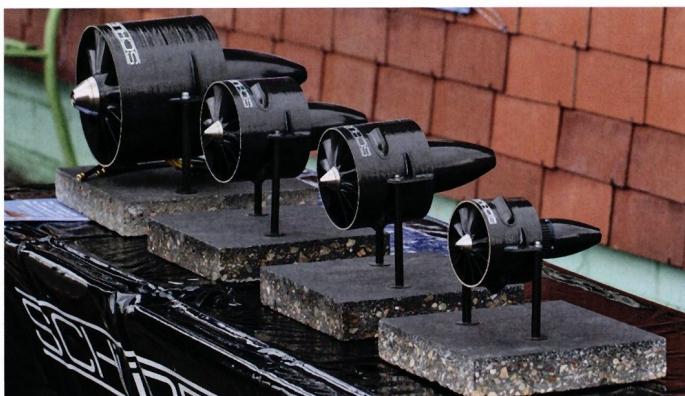
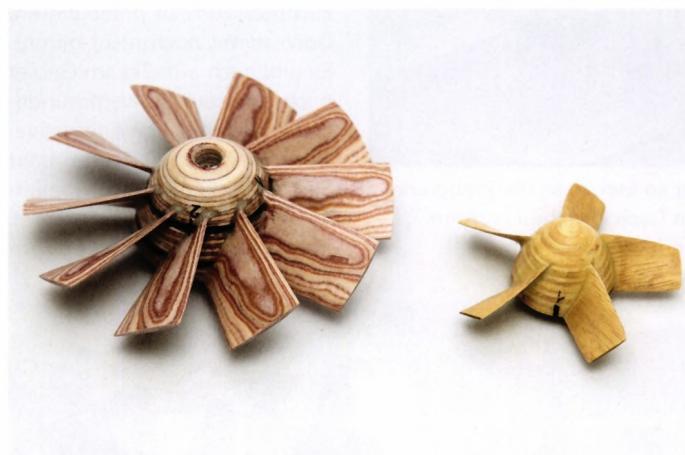
The impeller propulsion systems from the German company Schübler are well known among most electric jet pilots. Once again this year, the company’s CEO, Daniel Schübler, attended the Jet Meeting in person to present his latest developments in state-of-the-art CFRP technology to the assembled audience of experts. But that’s not all. There is also a very environmentally friendly and sustainable alternative in this field. For nearly 20 years now, Ueli Amacker has been building his impeller engines out of wood instead of the carbon fiber typically used
reinforced plastic. All components—including the casing, rotor, and associated blades—are made entirely from this natural material.
To ensure that the wooden blades do not shift from their designated positions on the rotor shaft due to the high centrifugal forces that occur during operation, they are...
| Scale: | 1:6 |
| Wingspan: | 2.12 m |
| Length: | 1.62 m |
| Weight: | 7.2 kg |
| Propulsion: | 120 mm Amacker impeller; 10-blade version with Leomotion L5038 motor, 8 kg of thrust on the test stand Battery: 12S 6200 mAh |
| Completely homemade according to my own design, made entirely of wood |
which additionally secures them in their designated positions with carbon-fiber strands. Meanwhile, Ueli is equipping his 120-mm engines with 10 rotor blades instead of just 5. This change actually results in a slight decrease in efficiency and a minor reduction in thrust. In return, it now produces a wonderful sound. This is more reminiscent of a steady hum rather than the previous aggressive howl. The resulting sound spectrum also closely resembles the characteristic sound of the original engine, much to the delight of the pilots at the controls. On a quiet Sunday afternoon, this soft murmur is sure to win over listeners who aren’t directly involved in the flight. Incidentally, these special engines are also very popular among Ueli’s fellow Impeller pilots. At least seven aircraft were equipped with them at this event.
This year, the weather held steady throughout the rest of the day, just as the earlier forecasts had predicted. As a result, it remained dry all afternoon. Unlike last year, only a gentle breeze blew across the airfield. This provided numerous additional opportunities for free flight on the large field. Contrary to the initial fears of some pilots, the unpredictable month of April ultimately showed its truly pleasant side. Finally, on behalf of all participants, we’d like to thank organizer Nello Nero and his helpers from MG Dübendorf for the careful preparation and successful execution of this year’s Jet Meeting. Many more photos from the event can be found online at [www.telesys.ch](http://www.telesys.ch) or [www.igejs.ch](http://www.igejs.ch).
Photo and text:
Hermann Mettler
| Wingspan: | 1.82 m |
| Length: | 1.62 m |
| Weight: | 4.6 kg |
| Drive: | 120 mm Amacker propeller; 5-blade version with Plettenberg 370/30/A2s motor, 1.5 kW, Schulze ESC Battery: 10S 5000 mAh |
| Homemade wooden fuselage; wings made of Styrofoam and balsa with Oraco bendable chrome film |


News from HEBU

EURO CONTEST GLIDER ACRO TOUR AUSTRIA 2026

TEAM MANAGER "THIS" BOSSHARD
 Rodito Nussbaumer

YOU KNOW WHAT I MEAN? 125 YEARS OF THE SWISS AERO CLUB
 Emil Giezendanner

F3A EUROPEAN CHAMPIONSHIPS IN ST-MACAIRE, FRANCE
 Matthias Bosshard

HORIZON HOBBY/LEMACO NEWS: MICRO OV-10 BRONCO 645 MM BY E-FLITE

PRIDE AND GOOD IDEAS
 Markus Nussbaumer

BY YOUTH, FOR YOUTH
Lorena Betschen
34th HAHNENMOOS ALPINE MODEL AIRPLANE CAMP
Res Dauwalder
TRY-OUT DAY AT MFV WETTINGEN
Urs Keller
52. 2026 ALPS CUP
Emil Giezendanner
TWIN TOWN PARTNERSHIP
Wolfgang Voeller
ATOM, THE NEW DOUBLE-DECKER FROM CPLR
Matthias Bosshard
CORSAIR F4U – A WARBIRD WITH A MEMORABLE LOOK
Jürgen Rosenberger, Jürgen Prinz
SUMMER FUN 2026 AT MG USTER
Martin Wunderli
What's New at Leomotion.com

THE PC-21 STORY
Emil Giezendanner
COUPE DES ALPES – OBSERVE AND LEARN
Rodito Nussbaumer
SMALL, MODEL-LIKE SAILBOATS
Res Dauwalder
WELCOME, NEW MEMBER!
Andrea Bolliger
FREE FLIGHT IN THE MIDDLE OF SUMMER
Urs Muntwyler
INSIGHTS INTO THE HISTORY OF SEAPLANES

NEWS FROM HEBU
 Julia Bucher

FROM 0 TO 100
Markus Nussbaumer
MEMORIES
Wolfgang Völler
NOS REGION – A HUB FOR ELECTRIC AVIATION
Emil Giezendanner
DO YOU KNOW WHAT I MEAN IN THE LAND OF SMILES?
Emil Giezendanner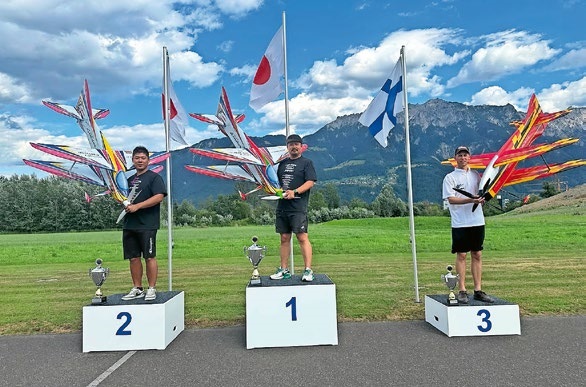
A SPECTACULAR F3A WORLD CUP IN THE PRINCIPALITY OF LIECHTENSTEIN
Emil Giezendanner