
Safety in Static Flight
Is there a safety issue with tethered flight? Hardly, since the models are held by lines and therefore cannot fly away uncontrollably. Furthermore, tethered flight is only practiced at specially designed, safe facilities!—That’s what one might think if they’re less familiar with this particular branch of model aviation. But the reality is significantly more complex.
Ever since tethered flight racing models have been reaching top speeds of over 300 km/h, and tethered flight acrobatics or beginner models have also been flown outside of designated tethered flight fields, there have been clear safety guidelines in tethered flight. But let’s take it one step at a time:
In Switzerland today, various categories of tethered flight are practiced:
- Speed and Team Racing as racing categories
- Acrobatics, Scale/Semi-Scale as aerobatics categories
The racing categories are flown exclusively at the specialized tethered flight facility Schwalbennest in Büsserach, Solothurn (Photo 1). This applies to both training and competition flights. Because the models fly at high speeds here—and in Team Racing, two to three models even fly in a circle at the same time—the models, lines, and pilots must withstand extreme stress. Despite—
In such cases, a model or parts of it may break off and fly away like a projectile. The pilot in the center of the circle will hardly be affected by this, since any such “projectile” will fly away from him. However, everyone else on the field who is unprotected is in immediate danger. To prevent this “worst-case scenario”—or at least minimize the risk of it—strict safety measures must be followed:
- The tethered flight runway must be surrounded by a safety fence. (Photo 1)
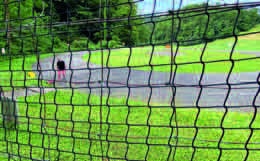
- For speed flights, a finer-mesh net is additionally stretched over the fence. (Photo 2)
- People who are not directly involved in the race are not permitted inside the safety fence.
- A line tension check is performed before the flight. This measures the strength of the lines in relation to the model’s weight. (Photo 3)
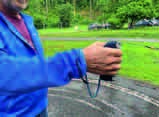
- The handle that the pilot uses to guide the lines is additionally secured with a hand loop. (Photo 4)
- Timekeepers, lap counters, and jury members who must remain inside the safety fence are shielded by a protective screen. (Photo 5)
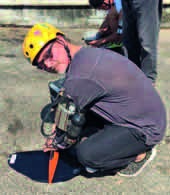
- If this is not possible—for example, for a mechanic on the Team Racing team—a protective helmet is required. (Photo 6)
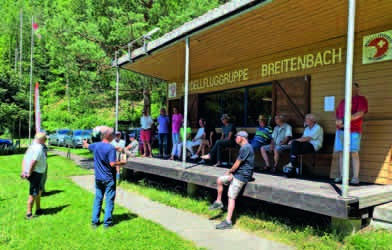
- Before competitions, pilots and helpers are each instructed on how to conduct themselves and how to direct spectators to the designated viewing areas. (Photo 7)
In the Acrobatics and Scale/Semi-Scale categories (including the flying of beginner models), the situation is somewhat different. Here, the models fly significantly slower and with less maneuverability, and there is no risk of “projectiles” flying off. Nevertheless, in the past, even these models were flown only within tethered flight areas. This was, however, more a matter of noise pollution than of safety. But since most of these “slow” models are now equipped with electric motors, flight noise is practically no longer an issue. This makes it possible—outside of competitions—to fly such models on a large open space or a flat, mowed meadow—provided, of course, that the owner gives permission. What about situations where there is no safety fence?
What is the potential risk involved? To answer this question, the following factors must be taken into account:
- With a few exceptions, tethered model aircraft cannot be brought down immediately once they are in the air.
- The pilot can only vaguely monitor what is happening around the airfield and can hardly prevent passersby from entering the airfield during a flight.
- The exact flight path of the model is difficult or impossible for laypeople to discern.
- The pilot usually has not marked a center point and may drift away from the designated flight area.
There is therefore a certain risk that a passerby might unintentionally enter the airfield and, in the worst-case scenario, come into conflict with a model. For this reason, there are two mandatory rules of conduct for “free” flying:
- You must never fly alone; you must always have an assistant present. (Photo 8)
- Assistants must be aware of the risks and be able to act accordingly. This means they must ensure that no bystanders (people or animals) unintentionally enter the danger zone. (Photo 9)
So, are there risks involved in tethered flight? Yes, there are. Tethered-flight pilots are aware of this and follow the safety rules described above. Thanks to this responsible behavior—and certainly a bit of luck as well—this exciting sport has been enjoyed without incident for many years. Let’s hope it stays that way. ■
Swiss Tethered Flight
Technical Commission, July 2022
Report in French and Italian at www.modellflug.ch/news/Sicherheit


News from HEBU

EURO CONTEST GLIDER ACRO TOUR AUSTRIA 2026

TEAM MANAGER "THIS" BOSSHARD
 Rodito Nussbaumer

YOU KNOW WHAT I MEAN? 125 YEARS OF THE SWISS AERO CLUB
 Emil Giezendanner

F3A EUROPEAN CHAMPIONSHIPS IN ST-MACAIRE, FRANCE
 Matthias Bosshard

HORIZON HOBBY/LEMACO NEWS: MICRO OV-10 BRONCO 645 MM BY E-FLITE

PRIDE AND GOOD IDEAS
 Markus Nussbaumer

BY YOUTH, FOR YOUTH
Lorena Betschen
34th HAHNENMOOS ALPINE MODEL AIRPLANE CAMP
Res Dauwalder
TRY-OUT DAY AT MFV WETTINGEN
Urs Keller
52. 2026 ALPS CUP
Emil Giezendanner
TWIN TOWN PARTNERSHIP
Wolfgang Voeller
ATOM, THE NEW DOUBLE-DECKER FROM CPLR
Matthias Bosshard
CORSAIR F4U – A WARBIRD WITH A MEMORABLE LOOK
Jürgen Rosenberger, Jürgen Prinz
SUMMER FUN 2026 AT MG USTER
Martin Wunderli
What's New at Leomotion.com

THE PC-21 STORY
Emil Giezendanner
COUPE DES ALPES – OBSERVE AND LEARN
Rodito Nussbaumer
SMALL, MODEL-LIKE SAILBOATS
Res Dauwalder
WELCOME, NEW MEMBER!
Andrea Bolliger
FREE FLIGHT IN THE MIDDLE OF SUMMER
Urs Muntwyler
INSIGHTS INTO THE HISTORY OF SEAPLANES

NEWS FROM HEBU
 Julia Bucher

FROM 0 TO 100
Markus Nussbaumer
MEMORIES
Wolfgang Völler
NOS REGION – A HUB FOR ELECTRIC AVIATION
Emil Giezendanner
DO YOU KNOW WHAT I MEAN IN THE LAND OF SMILES?
Emil Giezendanner
A SPECTACULAR F3A WORLD CUP IN THE PRINCIPALITY OF LIECHTENSTEIN
Emil Giezendanner