
Benedini Sound System Review
You could also say, “The sound defines the plane!” And what would a Ju-52 be, for example, without the magnificent, resonant sound of its three radial engines?
Years ago, some prophetically gifted individuals predicted that the time would eventually come when we would have to give these whisper-quiet model airplanes a little boost with electroacoustic measures to enhance their musical character. And let’s be honest: What does a fan of scale models feel when the aforementioned full-size Ju-52 flies majestically past him, emitting nothing but a high-pitched chirp? So I decided to equip my electrified Monocoupe 90 with a sound system to give it the beautiful sound of an original radial engine.
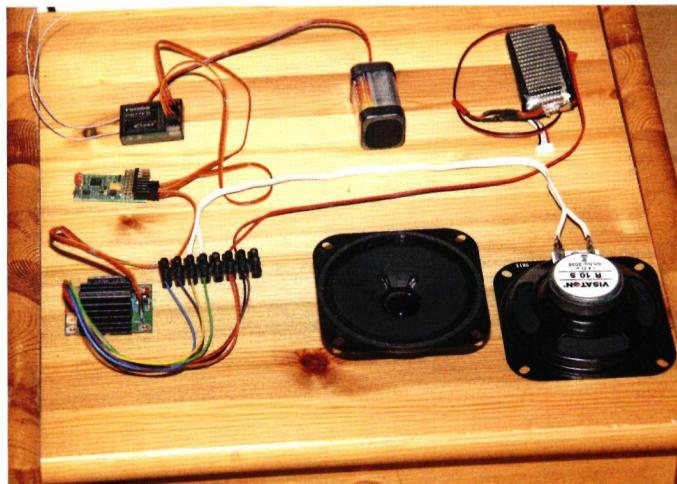
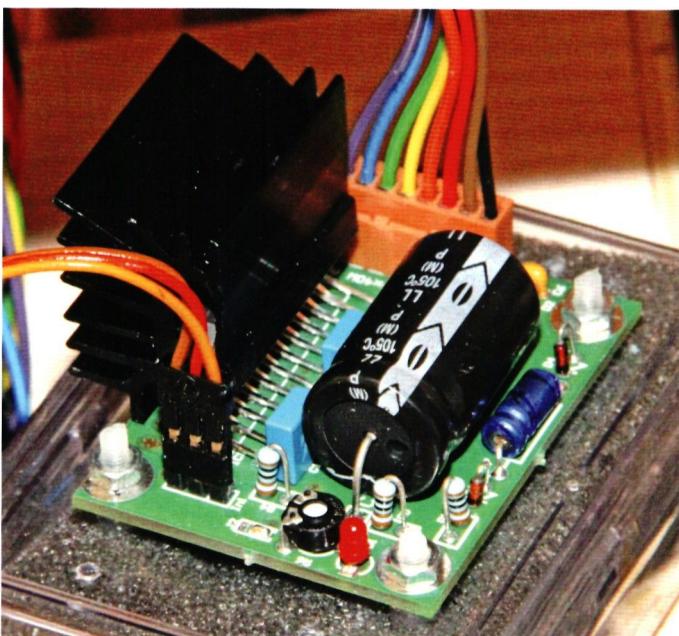
Benedini has been offering sound modules in various sizes and power classes for quite some time. For my Monocoupe with a 2.2-meter wingspan, I chose the most powerful version, consisting of the TBS Mini sound module, a 4×40-watt power amplifier—of which only two channels are currently in use— and two Visaton R10S speakers.
My intention with this report is not to promote “Lärm.” Now that our hobby is becoming socially acceptable among the general public—and especially among the lovely ladies (!)—thanks to LiPo batteries and brushless motors, we should
Don't mess with it. And in my opinion, the sound module is absolutely unsuitable for seaplane models in particular. Disturbing the wonderful tranquility of a lake is an absolute sacrilege! When I think of the many beachgoers who found my seaplane models so wonderful precisely because they’re so incredibly quiet, I don’t want to just go and destroy that newly earned goodwill. But there are places where you’re still allowed to make a little noise at certain times. It’s also worth noting that the volume of the engine sound is now fully adjustable. So you can even turn the sound system off completely at certain times and in certain places. But on a nice Saturday afternoon or during the week, you’ll certainly want to let the engine rumble a bit—as long as you’re not actually disturbing anyone—with relish and at the permitted volume.
It’s exclusively women who, when they find out that I’m working on restoring the engine sounds to a whisper-quiet electric model using a sound system, look at me with pity and—in a nice
and gently, but firmly, let me know that I’ve always been a bit eccentric with all my models, but that I’ve probably finally lost it now...
It’s completely different with the men: Yes, they get it and think this activity is absolutely “meaningful”!
We’re just a bit crazy, us men. And we’re actually a little proud of that.
The true intelligence of the Benedini sound system lies in its sound modules, which are available in various versions. The TBS Mini sound module I chose was developed specifically for use in electric aircraft and other functional models. It is fully programmable by the user via a PC. A wide selection of original recordings is available (e.g., Corsair, ME109, Spitfire, Cessna, trucks). My module already had the sound of a radial engine preloaded. In principle, however, any sound up to 93 seconds in length can be loaded onto the module via a PC. The TBS Mini offers an almost infinite number of possibilities, such as additional sounds, etc., which cannot all be listed here. Who
If you'd like to learn more, visit the Benedini website: www.benedini.de.
Our photo shows the setup of the system during the testing phase on the nightstands. The TBS Mini sound module receives its power supply and the signal for the rotational speed—that is, the frequency and type of motor noise—via the receiver’s output to the controller. The power amplifier requires a slightly higher supply voltage and operates at 9.6 V to 18 V. I chose a 3S LiPo with 1000 mAh—both because I had one on hand and for weight reasons. Initial tests were conducted without a LiPo saver, but the voltage was closely monitored throughout the entire test to ensure that the voltage of each individual cell did not drop below 3 volts. The sound of this combination, as it stands, is absolutely dreadful, because something quite crucial is missing...
As is well known, in order to achieve good bass reproduction and
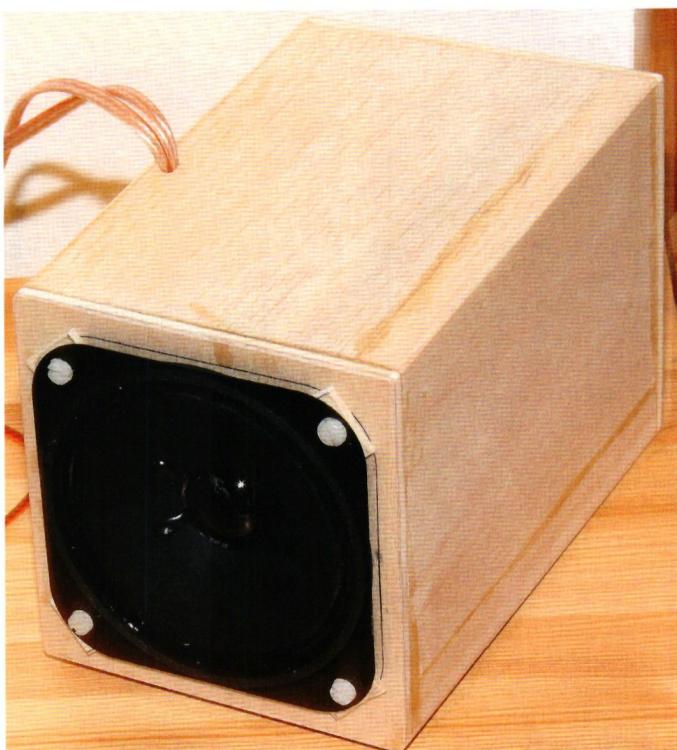
to avoid what is known as an “acoustic short circuit,” either a baffle as large as possible or an enclosure. Since my Monocoupe has a fuselage consisting of thin, foil-covered frames, I had to opt for an enclosure. So, a lightweight enclosure made of balsa and plywood was designed to fit the available space in my Monocoupe exactly. To prevent enclosure resonances, the enclosure was fitted with internal bracing and the sound-deadening wadding that is standard in hi-fi speakers. As a result, two speakers are now housed in a single enclosure—which is perfectly acceptable from an acoustic standpoint—and emit sound laterally to the right and left through the film covering the fuselage.
The total weight of my sound system is the sum of the following components:
- Enclosure (homemade) 90 grams
- TBS Mini sound module: 6 grams
- 4×40 W power amplifier: 40 grams
- 2 Visaton R10S speakers: 320 grams
- 3S 1000 mAh LiPo battery: 95 grams
- Various cables and mounting hardware: 49 grams
Total: 600 grams
It’s clear that only larger models can handle this 600 grams. Depending on the fuselage’s construction, a housing may not be necessary. Everyone must now decide for themselves whether their model can handle this additional weight and, if necessary, switch to a smaller and lighter version. We’ll find out later how my Monocoupe 90, with its lightweight wooden construction and a weight of about 5.5 kg (including a 6S LiPo), reacts to this additional weight.
After I had converted my Monocoupe 90 (see article in mfs 5/2012) from a seaplane back to a landplane, I set about installing the sound system. Initial tests in the workshop nearly damaged my sensitive musician’s ears, so I turned the volume down to the minimum setting on the power amplifier’s mini-potentiometer.
One problem is that the sound module starts to hum as soon as it’s turned on, regardless of whether the engine is running or not. Furthermore, even with the engine throttled all the way down, it’s not easy to turn off the engine noise. So, a specific output of the sound module is connected to a switching channel on the receiver. The sound can now be turned on and off at the desired time using this switch on the remote control. With a little practice, this works quite well. It’s annoying, though, when the propeller is stationary and the system is still running, or when the propeller is spinning but no beep can be heard.
And now it’s finally time to head out to the field—more specifically, to the Grischhei (ZH) Model Flying Club’s airfield. Since there are no noise issues there during the week and at permitted times, I turn up the potentiometer on the power amplifier until the LED next to it starts flashing briefly. That’s the maximum permitted volume before the power amplifier overheats and shuts down. Now the engine sound is robust but not annoyingly loud. And so comes the first flight with the sound system, which sounds absolutely convincing in terms of musicality. My Monocoupe 90 easily handles the extra 600 grams. Coincidentally, my son Felix also shows up at the airfield with his Sopwith Pup by Toni Clark, and a sound showdown ensues: the ZG 38 with a gearbox and giant propeller versus the 6S electric powerplant with the Benedini sound system. The jury—consisting of my wife/mother Maja, my son Benjamin, and two grandsons—isn’t quite in agreement: the women think it’s all silly anyway and are mainly enjoying basking in the sun, but my son Benjamin and grandson Liam react very positively to the Benedini sound. The fact is that the sound of the very well-muffled but relatively high-revving ZG 38 doesn’t sound very natural, despite the incredibly slow-turning giant propeller (thanks to the gearbox). Even Felix, the Sopwith builder, admits this candidly. The sound of my Monocoupe isn’t quite as lively, but it’s richer and therefore more authentic.
Anyone can join in on this afternoon of flying on YouTube, because my son Benjamin—at my request—traded his 3D foam glider, called “Venus,” for my camcorder and filmed the whole thing, for which I’m very grateful to him.
So open your browser on your computer and enter “Benedini Monocoupe 90” as a search term on Google or directly on YouTube—or go directly to <http://www.youtube.com/watch?v=bhX95ahufgY>
—and you’ll be right there with video and stereo sound.
When the speakers are installed optimally, the Benedini sound system selected here delivers
a symphony of engine sounds that, while not extremely loud, sounds astonishingly real. The fact that the volume is freely adjustable and the “noise” can even be turned off completely if needed ensures a very high level of environmental compatibility. – All in all, a brilliant toy. Not for the fairer sex, who show absolutely no appreciation for it, but exclusively for highly musical men! ■
Hans Jürg Baum


News from HEBU

EURO CONTEST GLIDER ACRO TOUR AUSTRIA 2026

TEAM MANAGER "THIS" BOSSHARD
 Rodito Nussbaumer

YOU KNOW WHAT I MEAN? 125 YEARS OF THE SWISS AERO CLUB
 Emil Giezendanner

F3A EUROPEAN CHAMPIONSHIPS IN ST-MACAIRE, FRANCE
 Matthias Bosshard

HORIZON HOBBY/LEMACO NEWS: MICRO OV-10 BRONCO 645 MM BY E-FLITE

PRIDE AND GOOD IDEAS
 Markus Nussbaumer

BY YOUTH, FOR YOUTH
Lorena Betschen
34th HAHNENMOOS ALPINE MODEL AIRPLANE CAMP
Res Dauwalder
TRY-OUT DAY AT MFV WETTINGEN
Urs Keller
52. 2026 ALPS CUP
Emil Giezendanner
TWIN TOWN PARTNERSHIP
Wolfgang Voeller
ATOM, THE NEW DOUBLE-DECKER FROM CPLR
Matthias Bosshard
CORSAIR F4U – A WARBIRD WITH A MEMORABLE LOOK
Jürgen Rosenberger, Jürgen Prinz
SUMMER FUN 2026 AT MG USTER
Martin Wunderli
What's New at Leomotion.com

THE PC-21 STORY
Emil Giezendanner
COUPE DES ALPES – OBSERVE AND LEARN
Rodito Nussbaumer
SMALL, MODEL-LIKE SAILBOATS
Res Dauwalder
WELCOME, NEW MEMBER!
Andrea Bolliger
FREE FLIGHT IN THE MIDDLE OF SUMMER
Urs Muntwyler
INSIGHTS INTO THE HISTORY OF SEAPLANES

NEWS FROM HEBU
 Julia Bucher

FROM 0 TO 100
Markus Nussbaumer
MEMORIES
Wolfgang Völler
NOS REGION – A HUB FOR ELECTRIC AVIATION
Emil Giezendanner
DO YOU KNOW WHAT I MEAN IN THE LAND OF SMILES?
Emil Giezendanner
A SPECTACULAR F3A WORLD CUP IN THE PRINCIPALITY OF LIECHTENSTEIN
Emil Giezendanner