
Obituary for Our Friend Max Moor
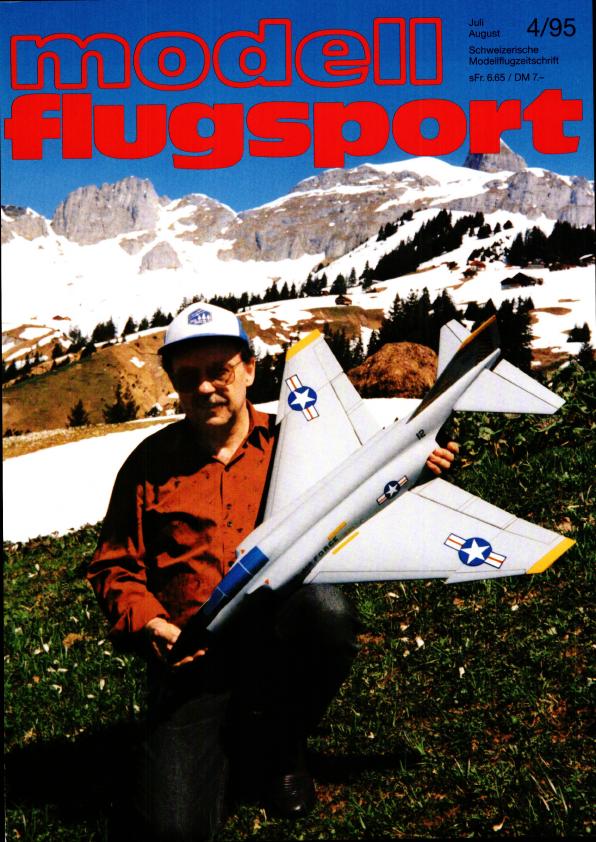
On June 22, 1995, we had the sad duty of bidding farewell to one of our best and most cherished friends. First and foremost, we would like to take this opportunity to express our heartfelt condolences—on behalf of all model aviators who knew Max, and especially those of the Affoltern a. A. Model Flying Club—to his wife Marlies, his son René and his family, his brother Hans, and all other relatives.
To all of us, Max was the very embodiment of a friend. He was always ready to help every fellow member—young or old—and was always there with plenty of valuable, sound advice. Whenever there were disagreements within the group, Max always remained the calming influence. But the group owes a large part of its success since its founding over four decades ago not only to his calm demeanor but especially to his outstanding expertise in many areas of our sport.
The chronicler still vividly recalls the years during and immediately after World War II, when a small group of enthusiasts wanted to found a model aircraft club in the Knonaueramt region. One of the most active members of that group was, of course, Max. And so it came to pass that, in our first workshop at the “Fuchshöhli” in Affoltern a. A., the group—which at the time was not yet affiliated with the AeCS—was founded; later, we merged with the equally new Bonstetten group, where we joined the AeCS model aviation movement. It was with this group that we celebrated our first successes, behind which—from a technical standpoint—Max was often the driving force, thanks to his outstanding expertise, his selfless advice, and his frequently brilliant new ideas. So it was only natural that, over 40 years ago, we founded “our” own model aviation group in Affoltern a. A., where Max served in many roles on the board over the years. Above all, his many years of service as a construction supervisor were a real asset to many young model aviators. We remember all too well the numerous model-building courses held at the Affoltern schoolhouse.
During my many years as chairman of the Bonstetten and Affoltern model flying clubs, as well as later as regional chairman, Max was always one of my most reliable and helpful friends. Not only were we able to discuss the countless challenges facing the rapidly growing model aviation movement—and his opinion usually aligned with my own—but whenever that was the case, I knew I was on the right track.
Unfortunately, at that time, the model aviation movement was still regarded as a “quantité négligeable” within the AeCS, and we often needed quite a bit of courage to negotiate with certain “veteran” representatives of the club.
But it wasn’t just the “political” problems of the model aviation movement; above all, there were organizational and technical problems to solve on a daily basis. I’m thinking of the many competitions and championships that had to be organized or attended at the regional, national, and international levels. Whenever we needed a reliable helper, Max never let us down. Just recently, for example, he did a tremendous amount of work to ensure the success of the exhibition marking the 40th anniversary of our model aviation group. It would be wonderful if the younger generations were as enthusiastic about the club as Max was—and if they, too, never asked how much compensation they would receive. Then we in model aviation would once again embody the true spirit of sportsmanship.
It would go beyond the scope of “model aviation” to detail all of Max’s flying and technical achievements here. It is with a touch of nostalgia that I look back on the countless hours spent tinkering with Max. Just a few examples may stir memories among the older model aviators and perhaps serve as an inspiration to the younger ones. How much time did Max devote to searching for new and better airfoil profiles in free flight, lighter construction methods, better engines, researching airflow conditions in slope flying (directional stability), and designing ever-new devices for high-altitude launches (initially, we had to launch with a 200-meter string, which then had to be reeled back in, and nylon was still unknown!), the construction of jet engines and the corresponding models, and the construction—and, of course, the ongoing development—of successful motorized models. But this tremendous work was surpassed by his immense enthusiasm for slope flying.
I don’t think I’m exaggerating when I say that two generations have already benefited from his developments in the F1E category. With “his” MAMO control system, controlled slope flying—unaffected by ground control—became a reality. This is where Max gained international recognition. In gratitude for his immense and selfless work, the Affoltern a. A. Model Flying Club named Max Moor an honorary member in 1974. Today we miss Max; we are saddened by his passing. On behalf of the Affoltern a. A. Model Flying Club:
Heinz Weiss

News from HEBU

EURO CONTEST GLIDER ACRO TOUR AUSTRIA 2026

TEAM MANAGER "THIS" BOSSHARD
 Rodito Nussbaumer

YOU KNOW WHAT I MEAN? 125 YEARS OF THE SWISS AERO CLUB
 Emil Giezendanner

F3A EUROPEAN CHAMPIONSHIPS IN ST-MACAIRE, FRANCE
 Matthias Bosshard

HORIZON HOBBY/LEMACO NEWS: MICRO OV-10 BRONCO 645 MM BY E-FLITE

PRIDE AND GOOD IDEAS
 Markus Nussbaumer

34th HAHNENMOOS ALPINE MODEL AIRPLANE CAMP
Res Dauwalder
TRY-OUT DAY AT MFV WETTINGEN
Urs Keller
52. 2026 ALPS CUP
Emil Giezendanner
BY YOUTH, FOR YOUTH
Lorena Betschen
ATOM, THE NEW DOUBLE-DECKER FROM CPLR
Matthias Bosshard
CORSAIR F4U – A WARBIRD WITH A MEMORABLE LOOK
Jürgen Rosenberger, Jürgen Prinz
SUMMER FUN 2026 AT MG USTER
Martin Wunderli
What's New at Leomotion.com

THE PC-21 STORY
Emil Giezendanner
COUPE DES ALPES – OBSERVE AND LEARN
Rodito Nussbaumer
TWIN TOWN PARTNERSHIP
Wolfgang Voeller
SMALL, MODEL-LIKE SAILBOATS
Res Dauwalder
WELCOME, NEW MEMBER!
Andrea Bolliger
FREE FLIGHT IN THE MIDDLE OF SUMMER
Urs Muntwyler
INSIGHTS INTO THE HISTORY OF SEAPLANES

NEWS FROM HEBU
 Julia Bucher

FROM 0 TO 100
Markus Nussbaumer
MEMORIES
Wolfgang Völler
NOS REGION – A HUB FOR ELECTRIC AVIATION
Emil Giezendanner
DO YOU KNOW WHAT I MEAN IN THE LAND OF SMILES?
Emil Giezendanner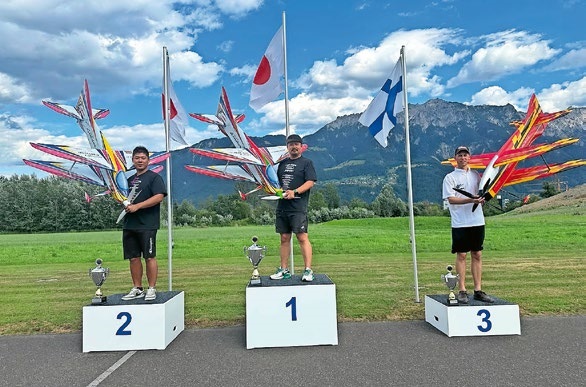
A SPECTACULAR F3A WORLD CUP IN THE PRINCIPALITY OF LIECHTENSTEIN
Emil Giezendanner