
Testimonial
Instead of a foreword, here are a few trivia questions for a change: What do the two models shown in the lead image have in common? (Please check the applicable options)
- ☐ Are completely
unsuitable for electric powertrains - ☐ Are inexpensive, quick-to-assemble ARF
models - ☐ Are made in
China - ☐ Are manufactured with high precision—
☐ Are made of an innovative, virtually indestructible
Kevlar-carbon sandwich— ☐ The kit is luxurious and comprehensively equipped
But, but, my dear model aviation colleague… only point 2 is true!
This review shows what can happen when a longtime combustion-engine pilot wants to find out whether an electric powertrain could be a serious alternative for him and his everyday models.
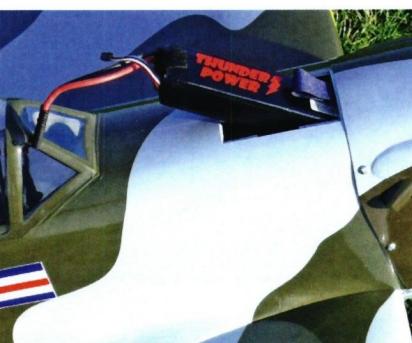
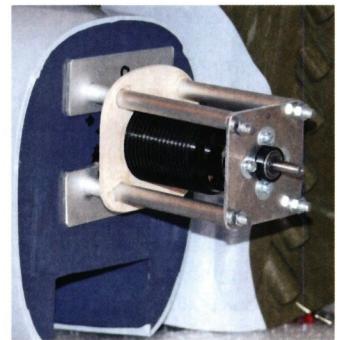
To ease the anticipation, let’s just say right now that these two very different models are powered by the new 1512/2D motor (Made in the USA) with a 6.7:1 gearset, the Phoenix 80 ESC, and two five-cell Thunder Power TPeXtr4600-5s1P LiPo batteries, each with a capacity of 4600 mAh
plus APC 17 × 10 electric propellers. Also included are the professional-looking Thunder Power LiPo Charger TP-1010C for 1 to 10 cells and the Thunder Power Balancer TP-205. However, this charging station does not run on 220 volts, but rather on 11 to 15 V. Since the use of a BEC is not recommended for LiPo batteries with more than 3 cells, a 1,200 mAh NC battery was used. Before the maiden flight, my clamp-on ammeter indicated a maximum current of 60 A, which the components used can easily handle. The measured static thrust of 4 kg, combined with the models weighing around 4 kg, promised some impressive flight performance.
www.top-modell.ch, from the manufacturer Lanyu, offers a Piper Cub J-3 with a wingspan of 2.07 meters for 384 francs. It struck me as a versatile model for my electric powerplant—perfect for cruising around, towing medium-sized gliders, and flying over water and snow. Two days after ordering it online, it arrived in the mail, and I could begin assembling this Chinese ARF kit. The model is constructed using a conventional, lightweight wooden design
. Unlike other ARF kits, however, quite a few parts were missing here. I was missing dummy engines, Piper Club stickers, some yellow film and tape, as well as material for the landing gear and tailplane struts. As with other ARF kits, I had to make up for the lack of precision here and there. Not even the center of gravity was specified in the rudimentary Chinese-English manual! The wings are only split upon delivery. Contrary to Topmodell’s instructions, they must be glued together, resulting in a wing the size of a small surfboard. When
a warped wing became visible—one that couldn’t be corrected with appropriate measures—my mood deteriorated noticeably. But just 24 hours after I filed a complaint with Topmodell—a company I must commend in general for its very reliable and very prompt service—I received a set of warp-free wings.
After I had made my own Piper decals and dummy engines using a photocopying process and fitted the model myself with a landing gear strut and tailplane braces, the model made a flawless impression—at least visually.
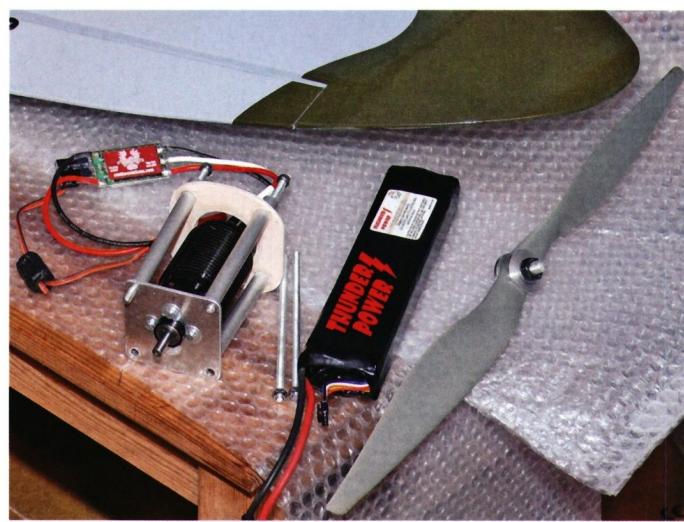
Powertrain optimized using the “Propeller Calculator” on the website www.eflight.ch: New 1512/2D motor with a 6.7:1 gear ratio, Phoenix 80 ESC, and a five-cell Thunder Power TPeXtr4600-5s1P LiPo battery, plus an APC 17 × 10 electric propeller.
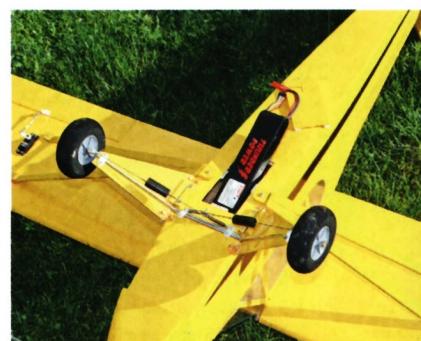
I set the center of gravity by positioning the LiPo optimally in the front third of the wing depth, i.e., 10 cm from the leading edge of the wing. According to my calculations, the wing loading of this model, which weighs about 4 kg, was a very pleasing 66 g/dm².
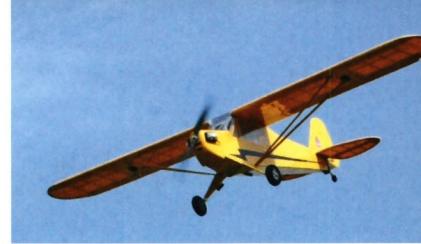
Right from the first takeoff, it became clear that it’s not all that easy to keep a Piper flying perfectly straight down the runway during takeoff. But as soon as it picks up even a little speed, it lifts off immediately and transitions into a gentle climb without needing much altitude adjustment. Once in the air, everything is smooth sailing—hardly any trim adjustments needed, excellent low-speed flight characteristics, and harmless stall behavior. Turns should be flown with the aid of the rudder. Adding a little rudder to the ailerons makes flying a lot more comfortable for pilots who don’t like to think too much—and I’m one of them. Landing this Piper takes some getting used to, mainly because of the relatively large propeller. Even at low RPMs, the thing just keeps flying and refuses to come down! If you reduce
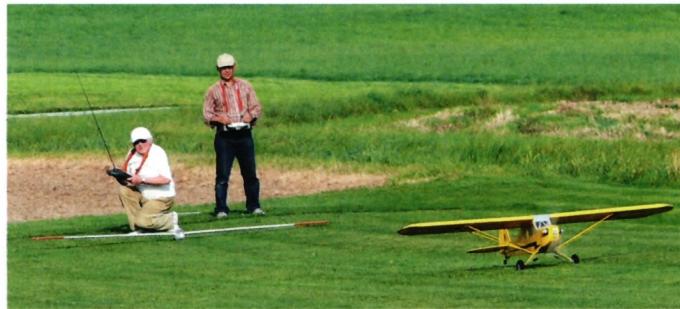
If you reduce the RPM even further, the propeller—which is now spinning very slowly—suddenly begins to slow down sharply, and the thing falls like a stone. But as they say, practice makes perfect! Gradually, I developed a feel for the very precise control required at the lowest RPMs, and this led to increasingly better landings with the propeller still just barely spinning—but not slowing down.
My colleague Hanno’s 3-meter glider, weighing just over 2 kg, was towed by the Piper with astonishing speed all the way to the horizon. My son Benjamin’s DG 800, weighing just over 3 kg with a 3.6-meter wingspan, also took off effortlessly within 60 to 90 seconds. We used a jettisonable
launch cart. Lighter gliders up to 4 meters should also be able to get airborne easily with a little skill and a launch cart.
Tip: Remove the tailplane struts when towing. The very first time we released the rope, it became tangled with the tail brace and tore it. The tangled mess of rope and cable then got stuck in the slot between the rudder and the tail—thankfully without blocking anything.
While enjoying a leisurely flight and practicing takeoffs and landings, the LiPo was drawing about 240 mAh per minute. That would result in a total flight time of about 16 minutes, with a little reserve to spare. Per tow
A 3-kg glider required 1,600 mA/h per flight. That means that per charge of the 4,600 mAh LiPo, you can easily fit in two tows and a 3-minute “reconnaissance flight.” If you want unlimited power and want to fly for a long time, you’ll need to buy a second or even a third LiPo and bring the charger with you.
For a long time, I’ve been dying to know whether a mid-sized Spitfire powered by an electric motor could still be fun to drive. But since I’d never seen one—and, more importantly, had never heard one—I just had to give it a try. The
The Lanyu-Piper's tried-and-true power system seemed to me to be just right for the Black Horse Modell Spitfire available at www.top-modell.ch, which costs 425
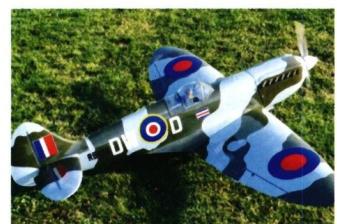
It’s available for francs. It has a wingspan of 1.81 m and is designed for four-stroke engines ranging from 15 to 20 ccm. This ARF assembly kit, largely prefabricated in Vietnam, contains a model that is very lightweight and astonishingly precise, crafted using conventional woodworking techniques, as well as everything you’d expect to find in a luxuriously equipped kit today. The only complaint is the spinner, which is far too small—and to make matters worse, it’s red. The few air bubbles in the film are quickly removed.
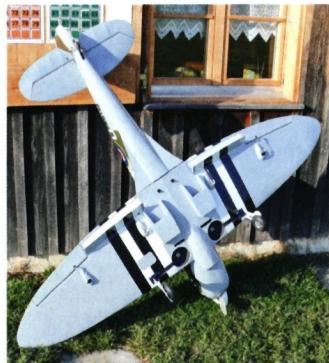
Assembling this top-notch material is a real pleasure. Of course, the installation of the motor and the battery compartment is left to the modeler’s imagination. The LiPo battery should be positioned as far forward as possible. This eliminates the need for any additional lead weight. The model ultimately weighed 4.2 kg ready to fly, resulting in a wing loading of approximately 78 g/dm². This value also promised absolutely trouble-free takeoff, flight, and landing performance. Unlike the original, the landing gear does not extend from the inside out, but rather retracts from the outside in
, which offers many advantages but is just as far from being true to the prototype as the high-gloss, distinctly too-clean-looking vinyl finish with stark color transitions.
The flight characteristics can only be described as “fantastic.” The model can be flown fast, but also incredibly slowly. From a certain height, the rapid, practically silent low-level flybys seem impressive—almost eerie. Extending the landing flaps—and this is hard for me to believe—doesn’t create any torque that needs to be counterbalanced with the elevator. Just set the flaps and glide in slowly and safely with a little throttle.
My admiration for this model reached its peak after a miserable plunge from a height of about 4 meters into the nearby stream bank. Upon impact, the wing was even torn off the fuselage! The reason for this mishap was a motor cut-off—yes, apparently that happens with electric models too!—at exactly the wrong moment: right as I was taking off. In my excitement, I’d completely forgotten about the time factor and
drained the LiPo battery during the second flight. Since I had unfortunately programmed the ESC’s shutdown behavior to “shut down immediately at 3 V” rather than “reduce power,” the ESC mercilessly cut off power to the motor! But lo and behold: aside from two broken plastic screws and a cowl that was only slightly dented on the underside, the apparently very sturdy lightweight construction had proven its worth. After about 90 minutes of maintenance at home—including cleaning, straightening the landing gear, replacing the propeller, etc.—the Spit flew just like before. However, the lightweight construction also has a drawback: You can’t just grab and squeeze the model anywhere when transporting it, or else the balsa—which is thin in certain spots—will start to creak. This ingenious model is strong only where it really needs to be.
I also noticed that flying a Spitfire is different from flying a Piper because of the significantly higher power requirements. Flight times per battery charge dropped dramatically. The engine cut-off taught me to limit flight times per LiPo charge to 7 to 9 minutes. That way, I still had some power left in the LiPo to spare it, the model, and my nerves.
My friend Hanno had already warned me beforehand: “Don’t you dare show up at Grischhei in a Spitfire with a landing gear that deploys incorrectly!” In front of the gathered crowd, the Spitfire put on a show with high-speed maneuvers, victory rolls, and everything else that goes with it. You could hear comments like “very nice flight pattern” or, during a negative loop, “I wonder if the original also
"Could it?" Hanno, with his eyes shaped like right angles, noted that this Spitfire clearly lacked V-shape—it didn’t look scale. Two people regretted that the engine sound was a bit lacking. But even President Heinz Lattmann said, “You’ve built a really nice model there.” And our aerobatics ace Hans Wüthrich remarked, “You really put it through its paces!” He added, “It flies so well because it’s light and has clean aerodynamics.”
Extreme noise restrictions don’t have to mean the end of model flying fun. The 1/5-scale Piper Cup J-3—originally designed for internal combustion engines—and the 1/6-scale Spitfire from Black Horse were easily converted to electric power and both demonstrated flawless handling and first-class flight performance.
Hans Jürg Baum,
MG Grischhei


News from HEBU

EURO CONTEST GLIDER ACRO TOUR AUSTRIA 2026

TEAM MANAGER "THIS" BOSSHARD
 Rodito Nussbaumer

YOU KNOW WHAT I MEAN? 125 YEARS OF THE SWISS AERO CLUB
 Emil Giezendanner

F3A EUROPEAN CHAMPIONSHIPS IN ST-MACAIRE, FRANCE
 Matthias Bosshard

HORIZON HOBBY/LEMACO NEWS: MICRO OV-10 BRONCO 645 MM BY E-FLITE

PRIDE AND GOOD IDEAS
 Markus Nussbaumer

BY YOUTH, FOR YOUTH
Lorena Betschen
34th HAHNENMOOS ALPINE MODEL AIRPLANE CAMP
Res Dauwalder
TRY-OUT DAY AT MFV WETTINGEN
Urs Keller
52. 2026 ALPS CUP
Emil Giezendanner
ATOM, THE NEW DOUBLE-DECKER FROM CPLR
Matthias Bosshard
CORSAIR F4U – A WARBIRD WITH A MEMORABLE LOOK
Jürgen Rosenberger, Jürgen Prinz
SUMMER FUN 2026 AT MG USTER
Martin Wunderli
What's New at Leomotion.com

THE PC-21 STORY
Emil Giezendanner
COUPE DES ALPES – OBSERVE AND LEARN
Rodito Nussbaumer
TWIN TOWN PARTNERSHIP
Wolfgang Voeller
SMALL, MODEL-LIKE SAILBOATS
Res Dauwalder
WELCOME, NEW MEMBER!
Andrea Bolliger
FREE FLIGHT IN THE MIDDLE OF SUMMER
Urs Muntwyler
INSIGHTS INTO THE HISTORY OF SEAPLANES

NEWS FROM HEBU
 Julia Bucher

FROM 0 TO 100
Markus Nussbaumer
MEMORIES
Wolfgang Völler
NOS REGION – A HUB FOR ELECTRIC AVIATION
Emil Giezendanner
DO YOU KNOW WHAT I MEAN IN THE LAND OF SMILES?
Emil Giezendanner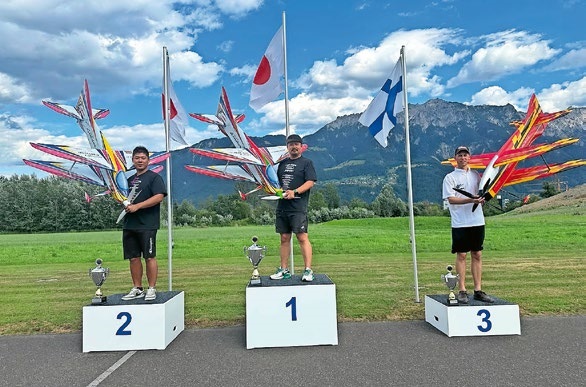
A SPECTACULAR F3A WORLD CUP IN THE PRINCIPALITY OF LIECHTENSTEIN
Emil Giezendanner