
Canard Avanti—the “refined” mallard
The "Canard Avanti" magnetic duck is an upgraded version of the "Stockente" Wild Duck.
The most striking feature is the relatively short, flat hull, which has a slender triangular cross-section extending roughly to the center of gravity and a rectangular cross-section at the rear of the hull. The forward side surface, which in the “Wild Duck” model was still designed as a separate nose fin, is incorporated into the forward section of the fuselage here. At 1,150 mm in length, the fuselage is kept relatively short so that it can fit undivided into a smaller transport case.
The control system is designed as a full tail control system with a fork reduction gear. The tail weight serves to balance the nose weight, which results from the increased fuselage cross-section and the robust nose tail unit.
The main wing itself has a higher aspect ratio than that of the predecessor model, the “Wild Duck,” and the wing bends are located behind the tips of the tailplane, so that the wing tip vortices of the leading edge, so to speak, fall into the bend, as tests with longer wool threads during “starved” flight indicated.
The main wing profile is slightly more cambered aft than on the “Wild Duck,” and the nose is also slightly more sharply bent. As a result, the center of gravity could be moved slightly further aft than on the predecessor model, and the EWD could even be reduced slightly.
The leading-edge wing profile was originally a “curved plate.” The underside was then filled in the first half, as with the “Wild Duck,” in the style of the Jedelsky standard profile. The EWD could then be reduced even further.
Initially, a 3-D turbulator made of 0.6 mm cardboard was used for the nose tail unit. This was later replaced by a pre-tensioned turbulence cord of approximately the same thickness.
Naturally, the flight performance of the “Canard Avanti” model is better than that of the “Wild Duck.”
Once trimmed for longitudinal stability, the model can be flown without any controls at all. This initial flight-testing phase should be carried out very thoroughly.
Please direct any inquiries or experience reports to:
Hans Gremmer, Oberbreitenauerstr. 11, D-8300 Landshut, Tel. 0871/7 36 31
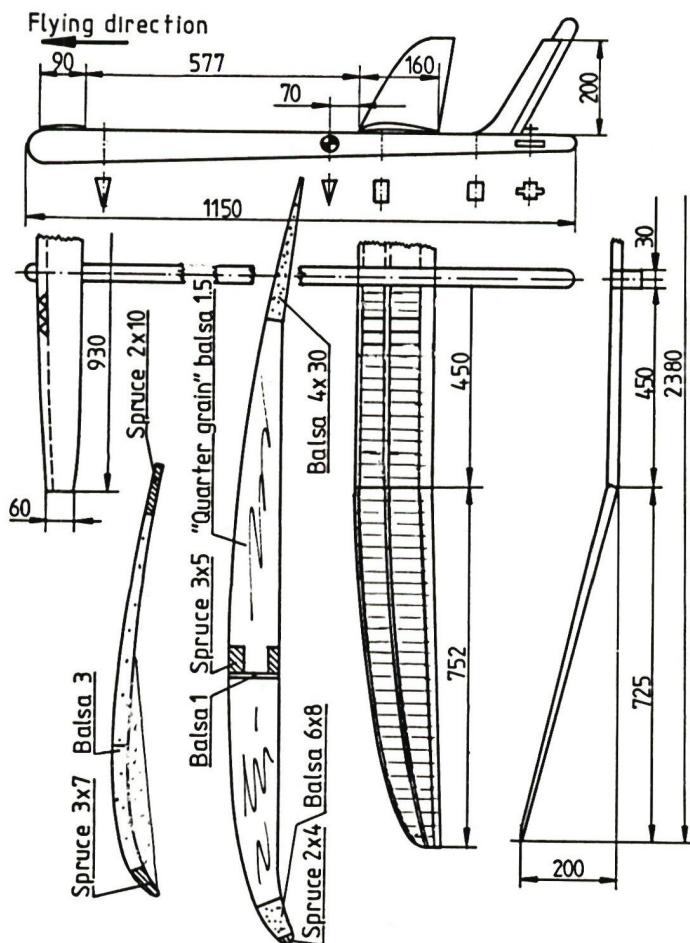
| Wingspan: | 2380 mm |
| Wing area: | 35 dm2 |
| Stab. area: | 7 dm2 |
| Surface area: | 42 dm2 |
| Weight: | 450 g |
| Loading: | 11 g/dm2 |
Drawing by P. D. G. Arghir
(und Gremmer)
Scale: 1:10, 1:1
Hans Gremmer
1989 F1E Glider


News from HEBU

EURO CONTEST GLIDER ACRO TOUR AUSTRIA 2026

TEAM MANAGER "THIS" BOSSHARD
 Rodito Nussbaumer

YOU KNOW WHAT I MEAN? 125 YEARS OF THE SWISS AERO CLUB
 Emil Giezendanner

F3A EUROPEAN CHAMPIONSHIPS IN ST-MACAIRE, FRANCE
 Matthias Bosshard

HORIZON HOBBY/LEMACO NEWS: MICRO OV-10 BRONCO 645 MM BY E-FLITE

PRIDE AND GOOD IDEAS
 Markus Nussbaumer

BY YOUTH, FOR YOUTH
Lorena Betschen
34th HAHNENMOOS ALPINE MODEL AIRPLANE CAMP
Res Dauwalder
TRY-OUT DAY AT MFV WETTINGEN
Urs Keller
52. 2026 ALPS CUP
Emil Giezendanner
TWIN TOWN PARTNERSHIP
Wolfgang Voeller
ATOM, THE NEW DOUBLE-DECKER FROM CPLR
Matthias Bosshard
CORSAIR F4U – A WARBIRD WITH A MEMORABLE LOOK
Jürgen Rosenberger, Jürgen Prinz
SUMMER FUN 2026 AT MG USTER
Martin Wunderli
What's New at Leomotion.com

THE PC-21 STORY
Emil Giezendanner
COUPE DES ALPES – OBSERVE AND LEARN
Rodito Nussbaumer
SMALL, MODEL-LIKE SAILBOATS
Res Dauwalder
WELCOME, NEW MEMBER!
Andrea Bolliger
FREE FLIGHT IN THE MIDDLE OF SUMMER
Urs Muntwyler
INSIGHTS INTO THE HISTORY OF SEAPLANES

NEWS FROM HEBU
 Julia Bucher

FROM 0 TO 100
Markus Nussbaumer
MEMORIES
Wolfgang Völler
NOS REGION – A HUB FOR ELECTRIC AVIATION
Emil Giezendanner
DO YOU KNOW WHAT I MEAN IN THE LAND OF SMILES?
Emil Giezendanner
A SPECTACULAR F3A WORLD CUP IN THE PRINCIPALITY OF LIECHTENSTEIN
Emil Giezendanner