
F3B – the optimization of different flying states
F3B is an FAI competition class for remote controlled (RC) sailplanes that covers the full bandwidth of performance radio control gliding. The three tasks, thermal duration, distance flight and speed flight pose contradictory requirements on the pilots and models, because one has to perform all these tasks with the same model. Effectively there is even a fourth task, namely the launch at the winch. The launch is the beginning of every task and a perfect winch launch is absolutely mandatory in F3B: «Launching is everything» (quoted from Tobias Knoblauch)!
These four tasks require the optimization of completely different flying states: flying with maximum lift during launching, with minimal sink in thermal duration, with the best gliding ratio in the distance task and with minimal drag in the speed task.
Beside the flying skills of the pilot and the performance of the plane, the weather also plays an important role in F3B as thermal activity can sometimes change quite quickly. To avoid «weather luck» in an F3B competition, the thermal duration and distance tasks are flown in groups (typically up to 12 pilots in thermal duration, up to 6 in the distance task). The best pilot of each group scores 1000 points, the others proportionally less. Therefore the influence of the weather can be compensated, the winner is the pilot who can most successfully handle the current conditions.
In contrast, the pilots have to fly one after the other in the speed task and the pilot with the fastest time scores 1000 points. Of course, the weather conditions can strongly influence the speed performance, therefore each pilot has a working time of 4 minutes in which the speed flight has to be accomplished. Thus an experienced competition pilot can choose – within some limits – the best moment to start. Only if the weather changes drastically (e.g. when it suddenly starts to rain), can the organizer split the speed task into smaller groups.

The reader might ask himself what is so special about these rather simple tasks in an F3B competition. Nearly every modeller has experienced successful thermal flights, all the F3B ships feature superb gliding ratios and flying fast with them is a piece of cake anyway, so what is so difficult about F3B? Well, when there is good thermal activity, the duration task is not that difficult, but what about difficult conditions, extremely poor air, turbulent wind or just really bad weather? It would be very naive to hope that in such conditions the other pilots will also not be able to fly the 10 minutes, because at least one pilot in each group will somehow manage to fly the full time.
Furthermore, let's assume that the models in the distance task have exactly the same gliding ratio (although flying a plane at the best gliding ratio requires a skilled pilot and good settings) and the weather conditions are constant (e.g. calm air in the evening). Despite the equal conditions, a beginner in F3B would normally not score the 1000 points. This can be very disappointing, because one cannot directly see what went wrong, either the launch height was not good enough, the turns were not optimal or something else was not perfect.
But the distance task is even more challenging, because the weather conditions are mostly not at all constant, thermal bubbles rise in some locations, but a little later there is only poor air left. Therefore the distance task is a four-dimensional optimisation problem, because it matters where (3D) and when one starts the flight. Furthermore, it is allowed to land and launch the plane again if a pilot realizes that he is flying in the wrong location.
Because there are so many possibilities, a pilot alone could not fly an optimal distance task by himself – he would for example not notice that other pilots have found good thermal activity. Therefore team work is required in this task and the pilot is advised by up to three helpers. Their job is to observe the other pilots, indicate the flying speed and to announce the turns at either end of the course. All in all, the distance flight is a very tactical task that, beside optimal control of the plane, requires a lot of experience from the pilot and the helpers.
But the speed task must be easy, F3B planes are fast anyway and we fly crisp speed turns each weekend at the slope, right?
Well flying an optimal speed turn is a different story, because the plane should conserve most of the kinetic energy, but flying this turn exactly at the end of the course, that is the real problem! Each metre the plane flies too far is doubled, because one also has to fly this extra distance in the opposite direction. On the other hand, if a pilot turns too early, no signal will sound and he has to fly back again, which costs a lot of speed and time.
Additionally, the speed task is often the most important task to separate the top pilots. So imagine the following situation: The last speed task is run in an inverted sequence (the best pilots start last) and the pilot that flies before you achieves an excellent speed flight. Now you know that you have to perform equally or even better to keep your position in the final ranking. And the pressure increases the nearer you are to the top pilots – at the last World Championships the very last speed flight decided who became world champion!
Beside that, the speed task is very spectacular because the planes fly at very high velocities (up to 160 km/h), so don't make mistakes in this task, otherwise you have to pick up your plane in very small pieces!


News from HEBU

YOU KNOW WHAT I MEAN? 125 YEARS OF THE SWISS AERO CLUB
 Emil Giezendanner

F3A EUROPEAN CHAMPIONSHIPS IN ST-MACAIRE, FRANCE
 Matthias Bosshard

What's New at Leomotion.com

52. 2026 ALPS CUP
Emil Giezendanner
PRIDE AND GOOD IDEAS
 Markus Nussbaumer

EURO CONTEST GLIDER ACRO TOUR AUSTRIA 2026

TEAM MANAGER "THIS" BOSSHARD
 Rodito Nussbaumer

HORIZON HOBBY/LEMACO NEWS: MICRO OV-10 BRONCO 645 MM BY E-FLITE

BY YOUTH, FOR YOUTH
Lorena Betschen
CORSAIR F4U – A WARBIRD WITH A MEMORABLE LOOK
Jürgen Rosenberger, Jürgen Prinz
SMALL, MODEL-LIKE SAILBOATS
Res Dauwalder
TRY-OUT DAY AT MFV WETTINGEN
Urs Keller
34th HAHNENMOOS ALPINE MODEL AIRPLANE CAMP
Res Dauwalder
SUMMER FUN 2026 AT MG USTER
Martin Wunderli
WELCOME, NEW MEMBER!
Andrea Bolliger
FREE FLIGHT IN THE MIDDLE OF SUMMER
Urs Muntwyler
THE PC-21 STORY
Emil Giezendanner
TWIN TOWN PARTNERSHIP
Wolfgang Voeller
ATOM, THE NEW DOUBLE-DECKER FROM CPLR
Matthias Bosshard
COUPE DES ALPES – OBSERVE AND LEARN
Rodito Nussbaumer
INSIGHTS INTO THE HISTORY OF SEAPLANES

NEWS FROM HEBU
 Julia Bucher

FROM 0 TO 100
Markus Nussbaumer
MEMORIES
Wolfgang Völler
NOS REGION – A HUB FOR ELECTRIC AVIATION
Emil Giezendanner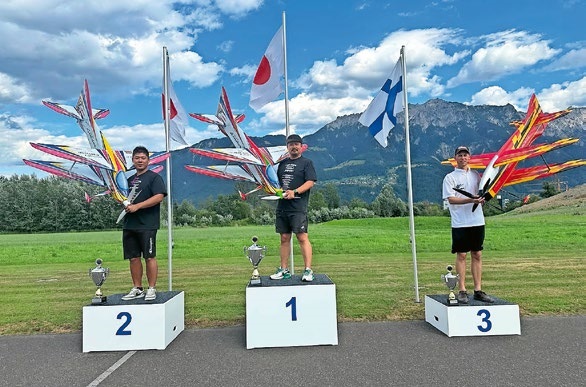
A SPECTACULAR F3A WORLD CUP IN THE PRINCIPALITY OF LIECHTENSTEIN
Emil Giezendanner
Have you almost forgotten about aircraft that take off and land vertically?
Emil Giezendanner